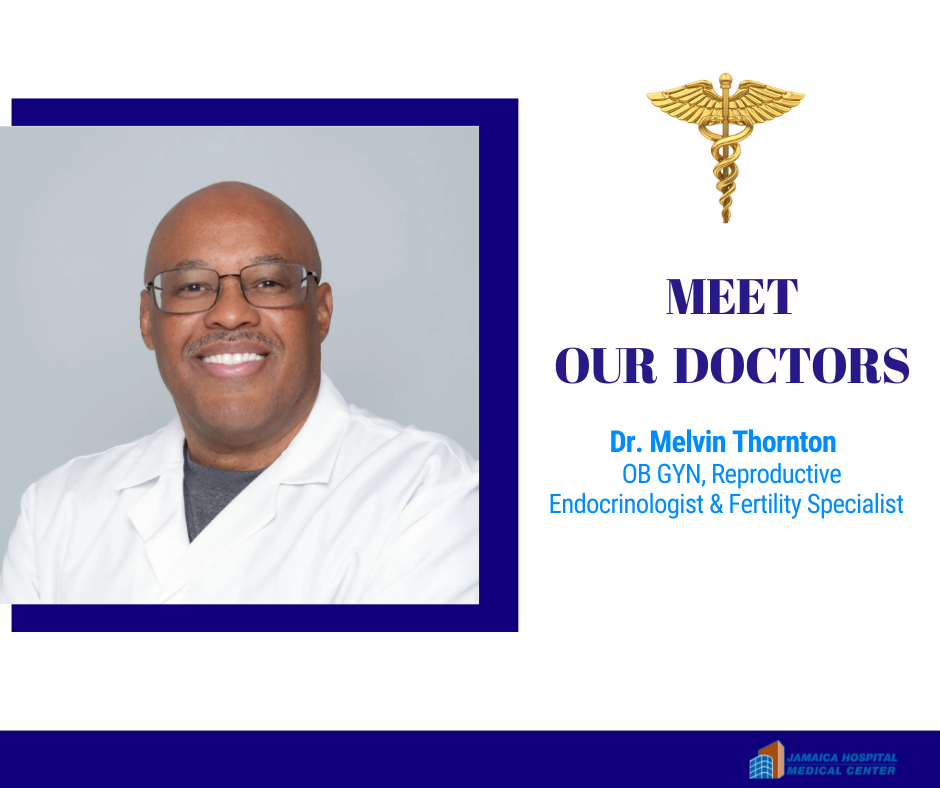
 We are pleased to introduce Dr. Melvin Thornton II, the newest member of the Obstetrics and Gynecology team at Jamaica Hospital Medical Center.
Dr. Thornton specializes in infertility, obstetrics and gynecology, and reproductive endocrinology. He chose this career path because, “in medical school I helped deliver my first baby and it was the most amazing thing in the world, and I will always remember that day. Then I realized that many couples could not experience the joy of having children, so I decided to dedicate my life and career to helping families have children,” he explained.
Born in Cleveland, Ohio, Dr. Thornton attended Oberlin College for his undergraduate degree and Washington University in St. Louis for medical school. He completed his residency in obstetrics and gynecology and reproductive endocrinology and infertility fellowships at the University of Southern California and L.A. County Hospital, where he was board-certified in both. He also completed his pelvic surgery fellowship at The Cleveland Clinic. Dr. Thornton treats female and male infertility, and female reproductive hormonal disorders, such as polycystic ovarian syndrome, prolactin, and menstrual disorders.
Recognized as one of the world’s leading experts in egg donation and surrogacy, Dr. Thornton has been helping families achieve their dreams for over 30 years and is excited to join the Jamaica Hospital team and practice in the community because he wants to help couples in the Queens area who are having difficulty conceiving. He is bringing his expertise in diagnosing and treating men and women to help them have children, as well as the opportunity for women to undergo fertility preservation, particularly for those diagnosed with cancer before undergoing cancer treatment.
Dr. Thornton has distinguished himself in the treatment of HIV serodiscordant couples and the relationship to infertility and fertility treatment through his extensive research. He has published more than 50 papers, written several book chapters, and presented over 100 abstracts at national conferences on topics related to infertility, third-party reproduction, and women’s health. He is an excellent educator and gives board review lectures for OB/GYN, Family Medicine, and Pediatrics residents preparing for their board examination.
Dr. Thornton currently lives in Central Valley, Orange County, New York, and is proud to practice in Queens. He joined the faculty at Columbia University, where he served as Medical Director and Director of the Egg Donation Program at the Center for Women’s Reproductive Care (CWRC). He previously was a member of the Accreditation Council for Graduate Medical Education (ACGME) Clinical Competency Committee for Obstetrics and Gynecology at Columbia University and currently sits on the American Society for Reproductive Medicine (ASRM) Education Committee and a member of the newly formed ASRM Diversity, Equity, and Inclusion Taskforce, which will enhance opportunities in reproductive medicine for underrepresented minority populations and reduce health disparities and access to care.
Dr. Thornton is a Castle Connolly National Top Doctor and was awarded the Top Doctor’s New York Metro Area Award in 2017, 2018, 2019, 2020-2026.
We are proud to welcome Dr. Thornton to our team and look forward to the work he and the rest of the Department of Obstetrics and Gynecology will provide high-quality care to our community.
Jamaica Hospital’s Department of Women’s Health Services provides a comprehensive range of inpatient and outpatient OB/GYN services to women in our community. You can schedule an appointment with an OB/GYN at Jamaica Hospital Medical Center’s Women’s Health Center. To learn more, please call (718) 291-3276.
 Follow
All content of this newsletter is intended for general information purposes only and is not intended or implied to be a substitute for professional medical advice, diagnosis or treatment. Please consult a medical professional before adopting any of the suggestions on this page. You must never disregard professional medical advice or delay seeking medical treatment based upon any content of this newsletter. PROMPTLY CONSULT YOUR PHYSICIAN OR CALL 911 IF YOU BELIEVE YOU HAVE A MEDICAL EMERGENCY.