The Emergency Contraceptive Pill

The emergency contraceptive pill (ECP), often referred to as the “Morning After Pill”, is a type of emergency birth control used to prevent pregnancy in women who have had unprotected sex or whose birth control method has failed.

Emergency contraceptive pills contain the medications levonorgestrel or ulipristal acetate.  Both delay or prevent ovulation when taken within 72 to 120 hours after contraceptive failure or having unprotected sex.  Pills containing ulipristal acetate require a prescription and those made with levonorgestrel can be purchased over the counter without a prescription.

It is important to note that while effective, emergency contraceptive pills do not prevent all pregnancies. According to The American Academy of Family Physicians, “Emergency contraception is about 75 to 85 percent effective.” 

Furthermore, they are less effective when taken beyond the recommended time of 72 to 120 hours after intercourse. The sooner they are taken the better.

Emergency contraceptive pills are generally safe to take; however, they should not be used if:

  • You know you are or think you might already be pregnant
  • You have a history of abnormal vaginal bleeding
  • You are allergic to the ingredients

Other precautions to keep in mind are:  ECPs should only be taken as a form of backup contraception. They should not be used for routine birth control. Lastly, these pills cannot be used to terminate a pregnancy.

The side effects of emergency contraceptive pills are mild and may include:

  • Headache
  • Fatigue
  • Breast tenderness
  • Abdominal cramps
  • Spotting (light bleeding)
  • Nausea or vomiting ( If you vomit within two hours after taking an emergency contraceptive pill, consult with your healthcare provider to determine if you should repeat the dose.)

If you are experiencing symptoms such as abnormally heavy or long-lasting vaginal bleeding, fevers or chills, pain during intercourse after taking ECPs, or missed periods within three weeks of taking the pill contact your doctor immediately.

To speak with a doctor at the Women’s Health Department at Jamaica Hospital Medical Center, please call 718-291-3276.

All content of this newsletter is intended for general information purposes only and is not intended or implied to be a substitute for professional medical advice, diagnosis or treatment. Please consult a medical professional before adopting any of the suggestions on this page. You must never disregard professional medical advice or delay seeking medical treatment based upon any content of this newsletter. PROMPTLY CONSULT YOUR PHYSICIAN OR CALL 911 IF YOU BELIEVE YOU HAVE A MEDICAL EMERGENCY.

Shining Our Employee Spotlight on Keila Tapia

This month we are proud to shine our Employee Spotlight on Keila Tapia.

Keila has been with Jamaica Hospital Medical Center for eight years and is an administrative assistant in the Security Department. She grew up in the East New York section of Brooklyn and currently lives in Queens.

Keila attended P.S. 214, John Adams High School, received her bachelor’s degree in business administration from Medgar Evers College in 2010 and currently is studying for her master’s degree in health administration at Capella University.

Family and friends are the most important part of her life. Keila enjoys spending time with them in her free time. She also likes to go to concerts, spend time outdoors, watch baseball games and go out to eat. Her favorite types of food are Mexican and Italian. Keila enjoys many genres of entertainment; however, her favorite type of movie are horror movies and she likes to listen to Latin and R & B music.

When she has the opportunity Keila likes to travel to places that have warm climates and beautiful beaches. Some of the places she has been to are Puerto Rico, St. Maarten, and the Dominican Republic where she spends time with her loved ones.

Keila enjoys working at Jamaica Hospital because it provides opportunities to keep growing within the organization and also because people work together so well as a team. We look forward to having Keila continue with us for many more years.

All content of this newsletter is intended for general information purposes only and is not intended or implied to be a substitute for professional medical advice, diagnosis or treatment. Please consult a medical professional before adopting any of the suggestions on this page. You must never disregard professional medical advice or delay seeking medical treatment based upon any content of this newsletter. PROMPTLY CONSULT YOUR PHYSICIAN OR CALL 911 IF YOU BELIEVE YOU HAVE A MEDICAL EMERGENCY.
Summer Skin Problems

Many people tend to spend more time outdoors during the summer months. This is a welcome change from the colder months when we spend most of our time indoors. However, more time spent outdoors can present challenges to the health of our skin.

These are a few of the conditions that can affect the skin during the summer months:

  • Sunburn – Caused by prolonged unprotected exposure to UV rays from the sun
  • Skin cancer – Caused by being exposed for prolonged periods of time to UV rays from the sun
  • Acne – Caused by bacteria on the surface of the skin mixing which blocks pores
  • Sun allergy – Caused by taking certain medications or having sensitivity to the sun
  • Plant rashes – Caused by coming in contact with poison oak, ivy, or sumac
  • Melasma – Caused by the sun making brown spots on the skin more noticeable
  • Prickly heat – Caused by blocked sweat glands which form tiny bumps on the surface of the skin
  • Seabather’s eruption – Caused by a reaction to seawater
  • Athletes feet – Caused by walking barefoot on damp surfaces without shoes in places such as communal showers, gyms, and wearing other peoples’ shoes

Many of these summer related conditions can be prevented by applying sunscreen with an SPF rating of 30 or higher, keeping the skin clean, wearing insect repellant, not wearing alcohol based perfumes, wearing protective clothing, wearing a hat, showering after being out in the sun and after swimming in seawater, and also avoiding being out and unprotected during the hottest times of the day. Following these tips can help prevent some of the summer skin problems that can occur.

If you would like to schedule an appointment with a physician at Jamaica Hospital Medical Center, please call 718-206-7001. If you are experiencing a severe reaction to any of the above conditions, seek medical care immediately.

All content of this newsletter is intended for general information purposes only and is not intended or implied to be a substitute for professional medical advice, diagnosis or treatment. Please consult a medical professional before adopting any of the suggestions on this page. You must never disregard professional medical advice or delay seeking medical treatment based upon any content of this newsletter. PROMPTLY CONSULT YOUR PHYSICIAN OR CALL 911 IF YOU BELIEVE YOU HAVE A MEDICAL EMERGENCY.

Jamaica Hospital Signs Formal Agreements With Local Cure Violence Groups To Help End Gun Violence In Our Community

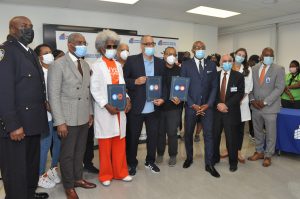
On Monday, June 13th, Jamaica Hospital Medical Center held an important event to address the gun violence epidemic in our community.

On that date, the hospital signed official partnerships with three members of The NYC Crisis Management System – King of Kings, Life Camp, and Rock Safe Streets as part of its commitment to end gun violence in our community. The objective of the landmark agreement is for all involved to work together to prevent violence and assist in protecting the health of patients and community members.

According to the formal collaboration, Jamaica Hospital will designate employees who will support the provision of anti-violence and violence interruption services by responding to referrals of traumas associated with gun violence. These designated employees will also assist in coordinating the visitation of Responders (individuals appointed by Cure Violence groups) with patients and loved ones, with their consent and as authorized by the law.

Responders’ duties include conducting follow-up visits during the inpatient stay with identified hospital patients, upon a determination by Jamaica Hospital that the patient is stable. Responders will provide supportive services such as mediation, conflict resolution, and service referrals to assist in the prevention of re-injury to these patients or to prevent retaliation connected to gun violence incidents.

Participating in the event were many local elected officials including Congressman Gregory Meeks, Queens District Attorney Melinda Katz, Queens Borough President Donovan Richards, Senator Leroy Comrie, and Chief Kevin Williams, NYPD Patrol Borough Queens South. Each official praised both Jamaica Hospital and the three members of The NYC Crisis Management System for working together to help end the gun violence crisis.

In addition, Dr. Katherine McKenzie addressed the audience to share information about Jamaica Hospital’s existing Violence Elimination and Trauma Outreach (VETO) program, which aimed to provide support for victims of gun violence as well as the hospital’s plans to create a dedicated center where gun violence victims can have all their clinical and social needs met as part of our Trauma Healing & Recovery Integrative Violence Elimination (THRIVE) Survivor Center.

After the presentation, Jamaica Hospital Medical Center President & CEO, Bruce Flanz signed formal Memos of Understanding to officially mark the occasion.

The event received significant media attention. To see the press clips, please click on the links below:

All content of this newsletter is intended for general information purposes only and is not intended or implied to be a substitute for professional medical advice, diagnosis or treatment. Please consult a medical professional before adopting any of the suggestions on this page. You must never disregard professional medical advice or delay seeking medical treatment based upon any content of this newsletter. PROMPTLY CONSULT YOUR PHYSICIAN OR CALL 911 IF YOU BELIEVE YOU HAVE A MEDICAL EMERGENCY.

Employee Spotlight Shines on Jonathan Benedek, LMSW

This month, we are proud to shine our Employee Spotlight on Jonathan Benedek, LMSW. Jonathan has been with Jamaica Hospital Medical Center for five years. He is a native of Queens and still resides in the borough. He attended elementary school at Yeshiva Tiferes Moshe in Kew Gardens, Mesivita Yesodei Yeshurun in Kew Gardens Hills for high school and Touro University where he obtained a BA in Psychology. He then received his Master’s Degree in Social Work from Touro Graduate School of Social Work.

Jonathan resides with his wife and they are expecting their first child in mid-July. In his free time he enjoys playing the piano/keyboard both for his own enjoyment and also to entertain at social events like birthday parties. He likes to cook with his wife and some of their favorite dishes to prepare are fish, pasta, chicken, and meat. Whenever he gets a chance, he enjoys a good bagel and also a nice slice of pizza. Jonathan also enjoys taking walks with his wife and engaging in religious studies.  Some of Jonathan’s favorite sports to watch and play are volleyball, tennis and soccer. He also enjoys hiking, camping, and zip lining.

Jonathan likes to travel and he has been to Florida, Rhode Island, Canada and Israel. In the future he hopes to visit places around the world that he has only visited virtually through Google Earth. Learning about other cultures is also very important to him.

Jonathan loves working at Jamaica Hospital because of his great co-workers and the diversity of the staff and the patients that they take care of. He enjoys being able to serve patients and assisting them with finding practical solutions to the challenges that they may be facing.  He feels that it is very important to treat people the way he would like to be treated.

We are very fortunate to have Jonathan as a member of our healthcare team at Jamaica Hospital and we hope that he remains with us for many more years.

All content of this newsletter is intended for general information purposes only and is not intended or implied to be a substitute for professional medical advice, diagnosis or treatment. Please consult a medical professional before adopting any of the suggestions on this page. You must never disregard professional medical advice or delay seeking medical treatment based upon any content of this newsletter. PROMPTLY CONSULT YOUR PHYSICIAN OR CALL 911 IF YOU BELIEVE YOU HAVE A MEDICAL EMERGENCY.

Tick-Borne Diseases

With summer in full swing, we will be spending more time participating in activities outdoors in areas such as parks, forests, and hiking trails.  While getting out and keeping physically fit is strongly encouraged it is important to keep in mind that being in these areas can put you at risk for tick-borne diseases such as Lyme disease.

Lyme disease is the most common tick-borne infection in New York City and in the United States.  On the east coast, Lyme disease is spread by the bite of a black-legged tick infected with the bacterium Borrelia burgdorferi.  Not all black-legged ticks carry this bacterium and, even if they are infected, they must be attached for at least 36 – 48 hours after a person is bitten to transmit the disease.

Although Lyme disease is common, it is not the only tick-borne disease to be wary of; other diseases include tularemia, babesiosis, ehrlichiosis, Rocky Mountain Spotted Fever, Southern Tick-Associated Rash Illness, Tick-Borne Relapsing Fever, and anaplasmosis.

The best way to avoid contracting Lyme disease and other tick-borne diseases is to avoid direct contact with ticks.  You can do this by avoiding wooded and brushy areas, and high grass.

The Centers for Disease Control and Prevention (CDC) also recommends the following to reduce exposure to ticks:

  • Wear a hat and light-colored clothing, including long-sleeved shirts and long pants tucked into boots or socks.
  • Use Environmental Protection Agency (EPA)-registered insect repellents containing DEET, picaridin, IR3535, Oil of Lemon Eucalyptus (OLE), para-menthane-diol (PMD), or 2-undecanone
  • Check your skin and clothes for ticks
  • Remember to check your hair, underarms, and groin for ticks.

Some of the tips to find and remove ticks from your body and clothing are:

  • Take a shower soon after returning indoors. If you wash within two hours of returning indoors, the ticks are more easily found and washed off your body.
  • Once you are indoors, take your clothing and place them in the wash using hot water and then put them in the dryer on “high” for at least 10 minutes; if the clothes were washed in cold water, place them in the dryer on “high” for at least 90 minutes

If you have been bitten, please consult a doctor immediately. Tick-borne diseases that are left untreated can cause arthritis, facial palsy, and nervous system problems. To schedule an appointment with a doctor at Jamaica Hospital Medical Center, please call 718-206-7001.

All content of this newsletter is intended for general information purposes only and is not intended or implied to be a substitute for professional medical advice, diagnosis or treatment. Please consult a medical professional before adopting any of the suggestions on this page. You must never disregard professional medical advice or delay seeking medical treatment based upon any content of this newsletter. PROMPTLY CONSULT YOUR PHYSICIAN OR CALL 911 IF YOU BELIEVE YOU HAVE A MEDICAL EMERGENCY.

Learning The Facts About Aphasia

Aphasia is a neurological condition that can affect your speech, as well as your ability to write and understand both spoken and written language.

Aphasia typically occurs after a stroke or a head injury, but it can also have a gradual onset as the result of a slow-growing brain tumor or a disease that causes degenerative damage. Sometimes temporary episodes of aphasia can occur. These can be due to migraines, seizures or a transient ischemic attack (TIA). A TIA occurs when blood flow is temporarily blocked to an area of the brain.

The severity of aphasia varies depending on the cause and the extent of the brain damage.

Some of the symptoms of aphasia include:

  • Speaking in short or incomplete sentences
  • Speaking in sentences that don’t make sense
  • Substituting one word for another or one sound for another
  • Using unrecognizable words
  • Not understanding conversations
  • Writing sentences that don’t make sense

Aphasia can create numerous quality-of-life problems because communication is so much a part of your life. Communication difficulty may affect your job, relationships, and general day-to-day functionality.  Communication difficulties can also lead to feelings of shame and depression.

Once the cause has been addressed, the main treatment for aphasia is speech and language therapy. The person with aphasia relearns and practices language skills and learns to use other ways to communicate. Family members often participate in the process, helping the person communicate.

Because aphasia is often a sign of a serious problem, such as a stroke, seek emergency medical care if you suddenly develop any symptoms.

All content of this newsletter is intended for general information purposes only and is not intended or implied to be a substitute for professional medical advice, diagnosis or treatment. Please consult a medical professional before adopting any of the suggestions on this page. You must never disregard professional medical advice or delay seeking medical treatment based upon any content of this newsletter. PROMPTLY CONSULT YOUR PHYSICIAN OR CALL 911 IF YOU BELIEVE YOU HAVE A MEDICAL EMERGENCY.

Diseases That Affect The Retina

The retina is found on the inside back wall of the eye. It is a thin layer of tissue that contains millions of light sensitive cells called rods and cones. These cells gather visual information and transmit it to the brain through the optic nerve.

Disorders of the retina can affect vision and lead to vision loss. In certain cases loss of vision can be prevented if retinal diseases are detected and treated early.

Some common types of retinal diseases include:

  • Retinal tears – occur when the gel like substance in the center of the eye shrinks and causes tugging on the retina to the point where it tears. Symptoms include seeing floaters and flashes of light.
  • Retinal detachment – occurs when fluid passes through a tear in the retina and accumulates behind the retina causing it to separate from the back wall of the eye.
  • Diabetic retinopathy – occurs in people who have diabetes. It is the condition where the tiny blood vessels in the back of the eye leak fluid causing the retina to swell. This leads to blurry vision.
  • Macular degeneration – occurs when the center of the retina begins to deteriorate causing a blind spot in the center of the visual field. There are two types of macular degeneration, wet and dry.
  • Retinitis pigmentosa – is an inherited disease and causes loss of night vision and peripheral vision.

Some common symptoms of retinal diseases include:

  • Blurry vision
  • Loss of peripheral vision
  • Loss of night vision
  • Appearance of floaters

If you are experiencing any changes in your vision it is important to see an eye doctor as quickly as possible. Depending on what the diagnosis is, there are treatment options available that may be able to help correct the condition. If you would like to schedule an appointment with an eye doctor at Jamaica Hospital Medical Center, please call 718-206-5900.

All content of this newsletter is intended for general information purposes only and is not intended or implied to be a substitute for professional medical advice, diagnosis or treatment. Please consult a medical professional before adopting any of the suggestions on this page. You must never disregard professional medical advice or delay seeking medical treatment based upon any content of this newsletter. PROMPTLY CONSULT YOUR PHYSICIAN OR CALL 911 IF YOU BELIEVE YOU HAVE A MEDICAL EMERGENCY.
Spring Cleaning – Naturally

Springtime means spring cleaning. If you’re looking for an alternative to store bought cleaners, check out these low-cost, non-toxic, environmentally friendly cleaning solutions for a fresh smelling home:

  • Baking Soda – cleans, softens water, and scours. You can also use baking soda to deodorize food storage containers and sprinkle on your carpet to absorb smells before vacuuming.
  • White Vinegar – cuts grease, removes mildew, odors, some stains and wax build-up. Use equal parts white vinegar and water to wash both the interior and exterior of your fridge.
  • Lemons  – effective against most household bacteria. Use lemon peels in your garbage disposal to help deodorize it.

You can also try these combinations:

  • All-Purpose Cleaner: Mix 1/2 cup vinegar and 1/4 cup baking soda into 1/2 gallon (2 liters) water. Store and keep. Use for removal of water deposit stains on shower stall panels, bathroom chrome fixtures, windows, and bathroom mirrors.
  • Mold and Mildew cleaner: Use white vinegar or lemon juice full strength. Apply with a sponge or scrubby.
  • Window Cleaner: Mix 2 teaspoons of white vinegar with 1 liter warm water. Use crumpled newspaper or cotton cloth to clean. Only use the black and white newspapers, not the colored ones. Don’t clean windows if the sun is on them, or if they are warm, or streaks will show on drying.
  • Furniture Polish: For varnished wood, add a few drops of lemon oil into a 1/2 cup warm water. Mix well and spray onto a soft, slightly damp, cotton cloth.  Wipe furniture with the cloth, and finish by wiping once more using a dry soft cotton cloth.

One more tip: Whenever you clean your home, save the floor or carpet for last. Clean window blinds and shelves first and then work downwards.  This allows time for the dust to settle before vacuuming.

All content of this newsletter is intended for general information purposes only and is not intended or implied to be a substitute for professional medical advice, diagnosis or treatment. Please consult a medical professional before adopting any of the suggestions on this page. You must never disregard professional medical advice or delay seeking medical treatment based upon any content of this newsletter. PROMPTLY CONSULT YOUR PHYSICIAN OR CALL 911 IF YOU BELIEVE YOU HAVE A MEDICAL EMERGENCY.

Jamaica Hospital Now Producing Podcasts For Our Community

Podcasts have become an increasingly popular medium to distribute information about a variety of topics. Millions of people listen to them to learn about many things including politics, entertainment, sports, and health. For this reason, Jamaica Hospital has begun producing and distributing podcasts to help members of our community learn how to better manage their health as well as how our hospital can provide valuable services to assist them.

The podcast which is named Jamaica Hospital MedTalk began production earlier this year. Each episode is approximately 15-minutes-long and features providers from various medical specialties discussing a wide range of topics. 

The podcasts can be found on multiple podcast platforms including Apple, Google, IHeart Radio, Spotify, Stitcher, and others.  In addition, those interested can listen to or download the podcasts on the hospital’s website. Episodes are also being shared on our social media platforms, including Twitter, Instagram, and YouTube.

Jamaica Hospital is dedicated to providing important information about health and wellness to our community. We are excited to utilize our podcasts as a new way to engage everyone.

To listen to any of the Jamaica Hospital podcasts, please click the link below:

https://jamaicahospital.org/podcast/

All content of this newsletter is intended for general information purposes only and is not intended or implied to be a substitute for professional medical advice, diagnosis or treatment. Please consult a medical professional before adopting any of the suggestions on this page. You must never disregard professional medical advice or delay seeking medical treatment based upon any content of this newsletter. PROMPTLY CONSULT YOUR PHYSICIAN OR CALL 911 IF YOU BELIEVE YOU HAVE A MEDICAL EMERGENCY.