
 Breast cancer happens when healthy breast cells become abnormal, multiply, and form tumors. Most breast cancers are carcinomas that start in milk ducts or milk-producing glands. Most cases are invasive, which means a tumor can spread to other parts of your body without treatment.
Breast cancer is one of the most common cancers that affects women. Approximately one in eight women in the U.S. will develop breast cancer in their lifetime. Although it is rare, male breast cancers also occur.
Most people who have breast cancer survive it. However, what a breast cancer diagnosis means is different for everyone. The cancer type, its stage, and your response to treatment are just a few factors that will shape your outlook.
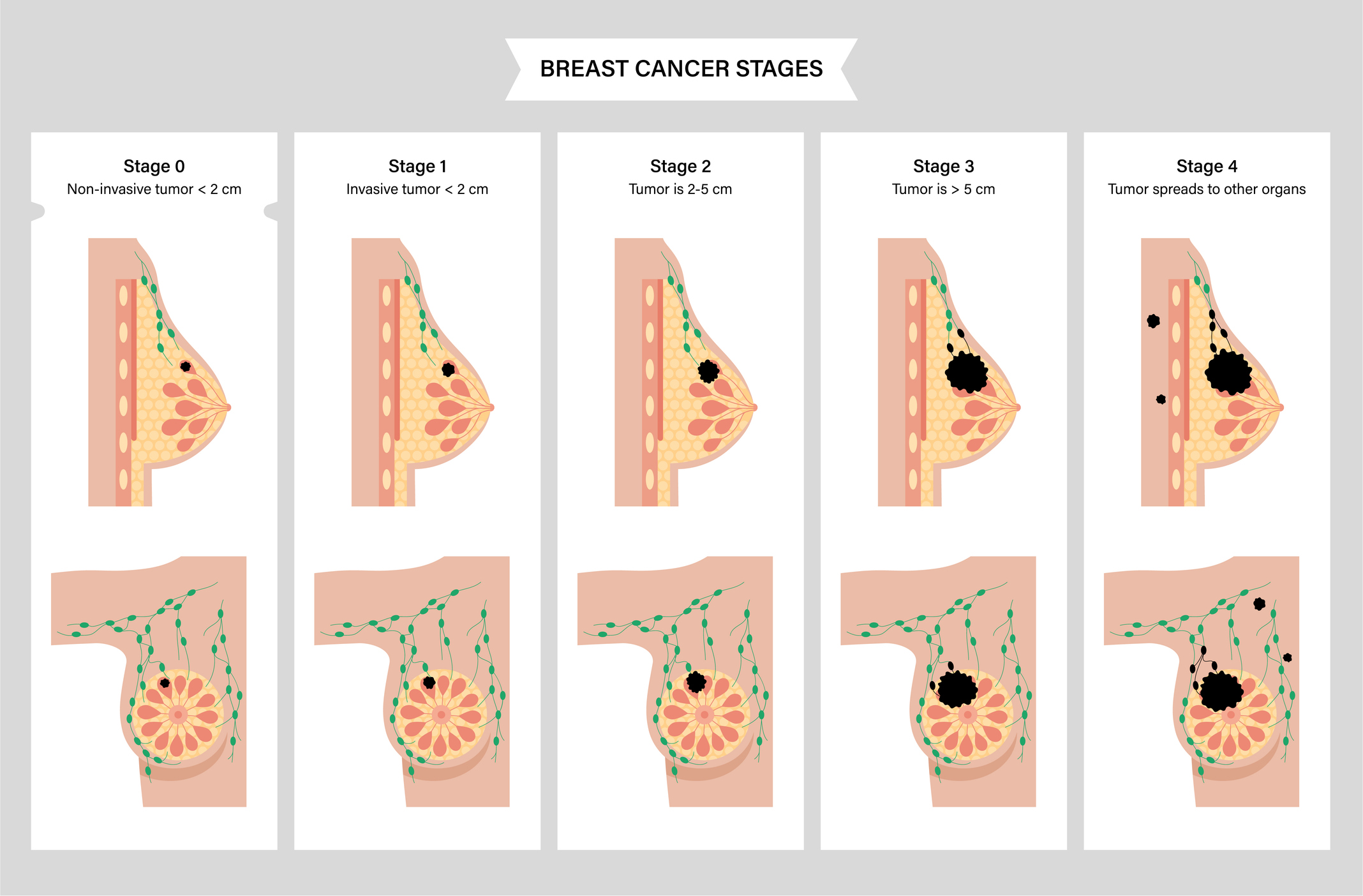
Cancer staging systems help healthcare providers plan treatment and understand your prognosis, or what to expect after treatment. The most well-known one is called the TNM system, which considers (T) tumor size and location, and whether cancer has spread to the (N) lymph nodes or (M) metastasized to other sites. Healthcare providers will use this information to stage breast cancer from 0 to IV. The higher numbered stages mean the disease is more advanced. The TNM stages are:
- Stage 0 describes non-invasive breast cancers, such as DCIS (ductal carcinoma in situ). Stage 0 doesn’t show any evidence of cancer cells or non-cancerous abnormal cells breaking out of the part of the breast in which they started or getting through to or invading neighboring normal tissue
- Stage I describes invasive breast cancer in which cancer cells break through to or invade normal surrounding breast tissue. Stage I breast cancer is divided into subcategories IA and IB:
-
- Stage IA describes invasive breast cancer that:
-
-
- Has a tumor that measures up to 2 cm
-
-
-
- The cancer has not spread outside the breast, and no lymph nodes are involved
-
-
- Stage IB describes invasive breast cancer that:
-
-
- Has no tumor in the breast, but small groups of cancer cells that are larger than 0.2 mm but not larger than 2 mm, and are found in the lymph nodes
-
-
-
- There is a tumor in the breast that is no larger than 2 cm, and there are small groups of cancer cells larger than 0.2 mm but not larger than 2 mm in the lymph nodes
-
- Stage II is divided into subcategories IIA and IIB:
-
- Stage IIA describes invasive breast cancer that:
-
-
- Has no tumor present in the breast, but is found in one to three lymph nodes under the arm or in the lymph nodes near the breastbone and is larger than 2 mm
-
-
-
- A tumor that measures 2 cm or smaller and has spread to the axillary lymph nodes
-
-
-
- The tumor is larger than 2 cm but not larger than 5 cm and has not spread to the axillary lymph nodes
-
-
- Stage IIB describes invasive breast cancer that:
-
-
- Has a tumor larger than 2 cm but no larger than 5 cm, and a small group of breast cancer cells larger than 0.2 mm but not larger than 2 mm are found in the lymph nodes
-
-
-
- The tumor is larger than 2 cm but no larger than 5 cm, and the cancer has spread to one to three axillary lymph nodes or to lymph nodes near the breastbone
-
-
-
- The tumor is larger than 5 cm but hasn’t spread to the axillary lymph nodes
-
- Stage III breast cancer is divided into subcategories IIIA, IIIB, and IIIC:
-
- Stage IIIA describes invasive breast cancer in which:
-
-
- No tumor is found in the breast, or the tumor may be any size, or cancer is found in four to nine axillary lymph nodes or in the lymph nodes near the breastbone
-
-
-
- The tumor is larger than 5 cm, or small groups of breast cancer cells larger than 0.2 mm but not larger than 2 mm are found in lymph nodes
-
-
-
- The tumor is larger than 5 cm, or the cancer has spread to one to three axillary lymph nodes or to the lymph nodes near the breastbone
-
-
- Stage IIIB describes invasive breast cancer in which:
-
-
- The tumor may be any size and has spread to the chest wall and/or skin of the breast, causing swelling or an ulcer
-
-
-
- May have spread to up to nine axillary lymph nodes
-
-
-
- May have spread to lymph nodes near the breastbone
-
-
- Stage IIIC describes invasive breast cancer in which:
-
-
- There may be no sign of cancer in the breast, or if there is a tumor, it may be any size and may have spread to the chest wall and/or the skin of the breast
-
-
-
- The cancer has spread to 10 or more axillary lymph nodes
-
-
-
- The cancer has spread to lymph nodes above or below the collarbone
-
- Stage IV describes invasive breast cancer that has spread beyond the breast and nearby lymph nodes to other organs of the body, such as the lungs, distant lymph nodes, skin, bones, liver, or brain
Whether you need diagnostic testing or treatment, the MediSys Cancer Center located at Jamaica Hospital Medical Center offers unmatched Queens cancer care for any form of cancer. To schedule an appointment or learn more about our New York hospital’s oncology department, please call 718-206-8263.
 Follow
All content of this newsletter is intended for general information purposes only and is not intended or implied to be a substitute for professional medical advice, diagnosis or treatment. Please consult a medical professional before adopting any of the suggestions on this page. You must never disregard professional medical advice or delay seeking medical treatment based upon any content of this newsletter. PROMPTLY CONSULT YOUR PHYSICIAN OR CALL 911 IF YOU BELIEVE YOU HAVE A MEDICAL EMERGENCY.