
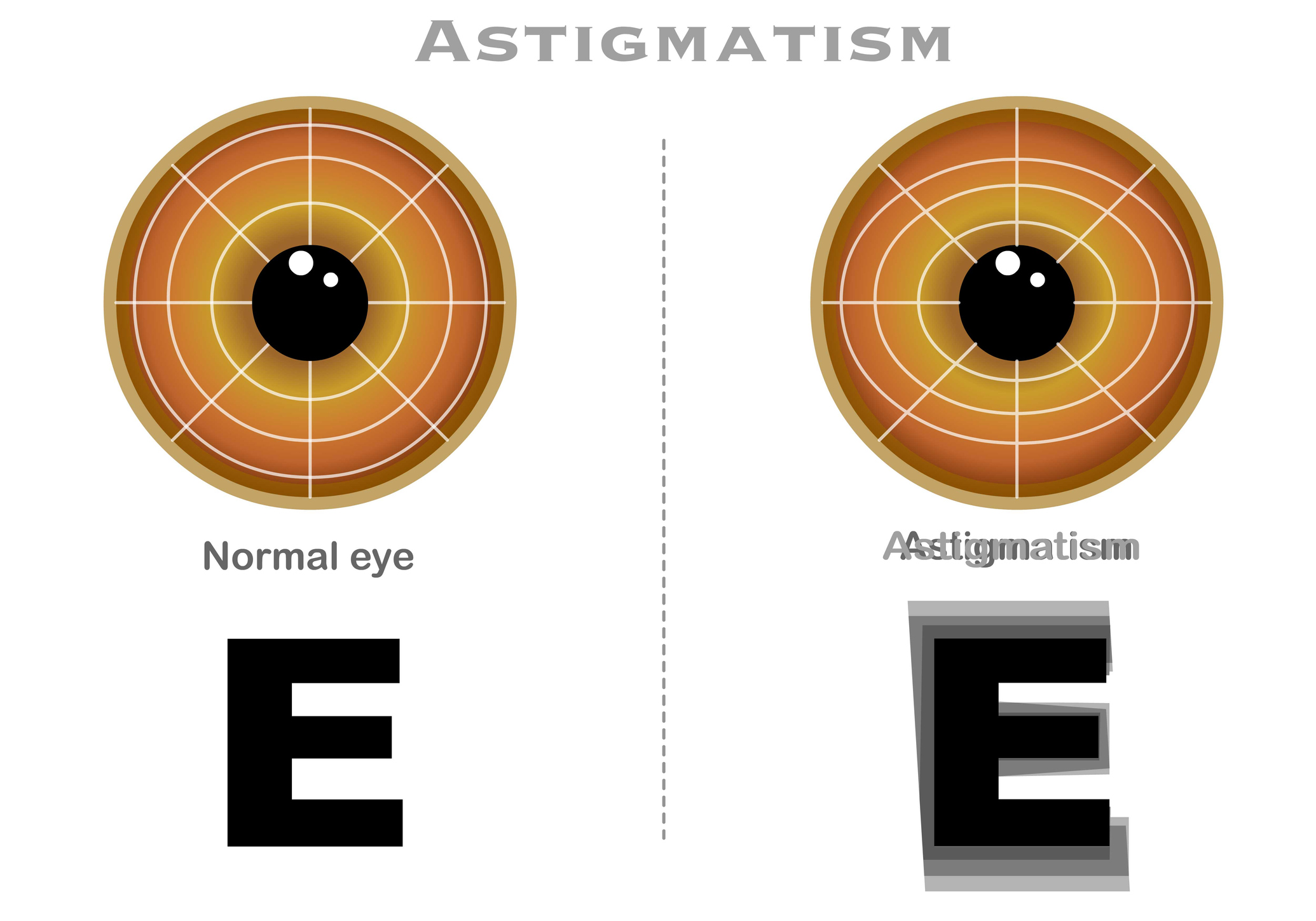
 Astigmatism is a common, generally treatable imperfection in the eye’s curvature that causes blurred distance and near vision. It occurs when the cornea (the surface of the eye) or the lens has mismatched curves, making the surface egg-shaped instead of round like a ball.
There are several signs and symptoms of astigmatism, including:
- Seeing glare, halos, or star-like patterns around lights
- Squinting
- Blurred or distorted vision
- Eye strain or discomfort
- Headaches
- Difficulty with night vision
- Fatigue
Astigmatism is a refractive error that may be present at birth or develop after an eye injury, disease, or surgery.
Other refractive errors that may occur in combination with astigmatism include:
- Myopia or nearsightedness– occurs when the cornea is curved too much, or the eye is longer than usual. Instead of being focused precisely on the retina, light is focused in front of the retina, which makes distant objects seem blurry
- Hyperopia or farsightedness– occurs when the cornea is curved too little or the eye is shorter than usual. When the eye is in a relaxed state, light never comes to a focus at the back of the eye, which makes nearby objects seem blurry
There are several risk factors for astigmatism, including:
- Genetics
- Keratoconus
- Eye injury
- Eye surgery
An eye doctor will perform an eye exam to help them diagnose astigmatism. The eye exam allows the doctor to check the health of your eyes and refraction. They will then use the results to determine the prescription needed to provide clear vision.
The goal of treating astigmatism is to improve vision clarity and eye comfort. Treatments for astigmatism include:
- Corrective lenses, such as eyeglasses or contact lenses
- Refractive surgery, which improves vision and reduces the need for eyeglasses or contact lenses. An eye surgeon uses a laser beam to reshape the curves of the cornea, correcting the refractive error. Types of refractive surgery include:
- Laser-assisted in-situ keratomileusis (LASIK)
- Laser-assisted subepithelial keratectomy (LASEK)
- Photorefractive keratectomy (PRK)
- Epi-LASIK
- Small incision lenticule extraction (SMILE)
Other types of refractive surgeries include clear lens extraction and implantable contact lenses. There is no single best method for refractive surgery, and you should decide only after a complete evaluation and a thorough discussion with your surgeon about which refractive surgery is best for you.
The Department of Ophthalmology at Jamaica Hospital Medical Center in New York provides a comprehensive range of medical, diagnostic, and surgical services for those with vision and eye conditions. Services are offered by some of the leading general, specialty, and pediatric ophthalmologists in Queens, NY. Please call 718-206-5900 to make an appointment.
 Follow
All content of this newsletter is intended for general information purposes only and is not intended or implied to be a substitute for professional medical advice, diagnosis or treatment. Please consult a medical professional before adopting any of the suggestions on this page. You must never disregard professional medical advice or delay seeking medical treatment based upon any content of this newsletter. PROMPTLY CONSULT YOUR PHYSICIAN OR CALL 911 IF YOU BELIEVE YOU HAVE A MEDICAL EMERGENCY.