#WorkoutWednesday Exercises That Work The Entire Body

It is recommended by the U.S. Department of Health that adults get 75 to 150 minutes of exercise each week; however, many do not have the luxury of time to work out frequently and some are confined to the office for eight hours or more each day.   Despite the limitations of a busy schedule, there are ways to fit a full body exercise regimen into your daily routine.

Some examples of full body exercises are:

  • Push-ups
  • Squats
  • Burpees
  • Lunges

Exercise is essential to your health. Although your schedule may be hectic, try to find the time for a few minutes of physical activity into your daily routine.

If you would like to learn more about the how to safely implement the techniques listed above, visit https://www.medicalnewstoday.com/articles/324895#lunges

All content of this newsletter is intended for general information purposes only and is not intended or implied to be a substitute for professional medical advice, diagnosis or treatment. Please consult a medical professional before adopting any of the suggestions on this page. You must never disregard professional medical advice or delay seeking medical treatment based upon any content of this newsletter. PROMPTLY CONSULT YOUR PHYSICIAN OR CALL 911 IF YOU BELIEVE YOU HAVE A MEDICAL EMERGENCY.

COVID-19 Myth or Fact

A very common myth is that Covid-19 affects older people more severely than younger people. The fact is that while older people tend to have more risk factors, people of any age can and do get the virus. A younger person may have a more robust immune system but it will not prevent them from getting the virus. Younger people can be affected just as severely as an older adult.

If you would like to schedule an appointment with a physician at Jamaica Hospital Medical Center, you may do so by calling 718-206-7001.

All content of this newsletter is intended for general information purposes only and is not intended or implied to be a substitute for professional medical advice, diagnosis or treatment. Please consult a medical professional before adopting any of the suggestions on this page. You must never disregard professional medical advice or delay seeking medical treatment based upon any content of this newsletter. PROMPTLY CONSULT YOUR PHYSICIAN OR CALL 911 IF YOU BELIEVE YOU HAVE A MEDICAL EMERGENCY.
#WorkoutWednesday – Low Intensity Running

It is no secret that exercise does wonders for your health.  Running, in particular, offers many benefits, and is known to improve your mental and physical wellbeing.

In a study published in the Journal of the American College of Cardiology, it was found that” five to 10 minutes a day of low-intensity running is enough to extend life by several years.” Similar studies have also indicated that running can help reduce the risks associated with obesity, diabetes, heart disease, high blood pressure and some cancers.

Given the benefits, your doctor may recommend that you include running as part of your exercise regimen. If you decide to run, there are a few things you should keep in mind in order to prevent injury and optimize your workout. Here are some running dos and don’ts:

The Do’s:

  • Keep your head up -This will keep your body in alignment and prevent injuries
  • Stretch and warm up-This reduces muscle tightness and increases your range of motion
  • Start slowly -Starting off too fast can lead to overexertion which may result in side aches
  • Schedule rest days –Allow your body days to recover and reduce the risk of exhaustion
  • Remain hydrated- Drinking enough water will prevent dehydration

The Don’ts:

  • Do not run in shoes that are worn or not intended for running- Shoes that are worn or not designed for running may lack support and lead to injuries
  • If running outdoors, do not run with headphones – It is important to be aware of your surroundings and avoid hazards
  • Do not eat big meals before running-Eating too much can slow you down
  • Do not ignore injuries- It is important that you rest if you are injured, not doing so can lead to complications

The most important thing to consider before starting your running routine is to speak with your doctor. Experts recommend that you receive a full medical checkup if you are over the age of 40, have preexisting medical conditions, are obese or have a family history of heart disease.  Your doctor will be able to assess your health and determine if running is best for you.

All content of this newsletter is intended for general information purposes only and is not intended or implied to be a substitute for professional medical advice, diagnosis or treatment. Please consult a medical professional before adopting any of the suggestions on this page. You must never disregard professional medical advice or delay seeking medical treatment based upon any content of this newsletter. PROMPTLY CONSULT YOUR PHYSICIAN OR CALL 911 IF YOU BELIEVE YOU HAVE A MEDICAL EMERGENCY.
Employee Spotlight Shines on Karen Codd

This month, we are proud to shine our Employee Spotlight on Karen Codd, Community Wellness Coordinator in the Department of Psychiatry.

Karen has been working at Jamaica Hospital Medical Center since 2015, first as a creative arts therapy extern and then for the past four years and eight months as a full-time creative arts therapist.

Karen is a native of Somerville, New Jersey, where she attended elementary through high school. She then graduated from The College of St. Rose where she obtained her Bachelor of Fine Arts, majoring in Sculpture and minoring in Art History and Photography. She later received a Master of Professional Studies degree in Art Therapy and Creativity Development from the Pratt Institute and is now part of their Graduate Art Therapy faculty. Karen is currently working towards a Doctorate of Art Therapy from Mount Mary University.

Karen has been living in Brooklyn for almost 16 years and shares her home with two cats, Vicky and Trish. In her free time, she enjoys watching movies, playing music, visiting museums and spending time with friends. Travelling the world is also one of her passions; her favorite places visited so far are Chile, Turkey, and India. She likes eating a variety of cuisines from different parts of the globe; however, Asian dishes are her favorite.

According to Karen, being of service to others is her true calling. She is grateful to have the support of her department’s administration which allows her to pursue her passions and research interests. Working at Jamaica Hospital has allowed her to utilize her knowledge of the arts and its therapeutic benefits to help mental health patients during some of the most difficult times in their lives.

All content of this newsletter is intended for general information purposes only and is not intended or implied to be a substitute for professional medical advice, diagnosis or treatment. Please consult a medical professional before adopting any of the suggestions on this page. You must never disregard professional medical advice or delay seeking medical treatment based upon any content of this newsletter. PROMPTLY CONSULT YOUR PHYSICIAN OR CALL 911 IF YOU BELIEVE YOU HAVE A MEDICAL EMERGENCY.
Ayshea Beswick-Bailey Shares Her “Jamaica Journey”

Thousands of people work at Jamaica Hospital and each has their own unique story to tell about their career path.  The following is one of them.

Ayshea Beswick-Bailey RN, MSN, PMHNP; Clinical Nurse Manager for Psych-3, began her career journey at Jamaica Hospital Medical Center 17 years ago.

Driven by a strong desire to care for others, Ayshea pursued a career in nursing “I always knew I wanted to be a nurse. As a child I enjoyed helping people and was intrigued by anything related to medicine,” she shared.

In 2003, she joined Jamaica Hospital as a Licensed Practical Nurse on 3-North. After receiving her Bachelor of Science in Nursing from Lehman College, Ayshea honed her clinical expertise by working in various areas of the hospital as a Float Team RN.  Her next career stop was the E.R., where she worked for almost 10 years.  For Ayshea, working in the E.R. was one of her best experiences.  She said there is no limit to what you can learn there.

Ayshea used the knowledge and experience she gained in the E.R. to transition to the Psychiatry department. While working as a Staff Nurse, Ayshea completed the Master of Science program at Hunter College and received her degree as a Psychiatric Mental Health Nurse Practitioner.

Throughout her journey at Jamaica Hospital, Ayshea has become known by many for her strong work ethic and willingness to go above and beyond. In fact, she was nominated for a G.E.M award which is given to employees who go the extra mile to help patients and colleagues.

In addition to her commitment to providing excellent care to patients, Ayshea credits her professional growth to the support of her mentors and colleagues.  “My first mentor at Jamaica hospital was Linda Hayes, the Assistant Director of Nursing Administration. She always pushed me and believed in me,” she stated. “I am also very grateful that other leaders such as Marge Lilienthal, Liz Garcia, Dr. Daniel Chen, Dr. Martha Edelman and Dr. Meri Nisimova gave me a chance.”

When asked about her overall experience of working at Jamaica Hospital, Ayshea replied, “I know this may sound cliché, but it is the truth, working at Jamaica Hospital has truly been like working with family. My colleagues have been there during the difficult and best times in my life, including my dad’s cancer diagnosis and recovery, as well as the birth of my kids, two of which I had at this hospital.”

All content of this newsletter is intended for general information purposes only and is not intended or implied to be a substitute for professional medical advice, diagnosis or treatment. Please consult a medical professional before adopting any of the suggestions on this page. You must never disregard professional medical advice or delay seeking medical treatment based upon any content of this newsletter. PROMPTLY CONSULT YOUR PHYSICIAN OR CALL 911 IF YOU BELIEVE YOU HAVE A MEDICAL EMERGENCY.
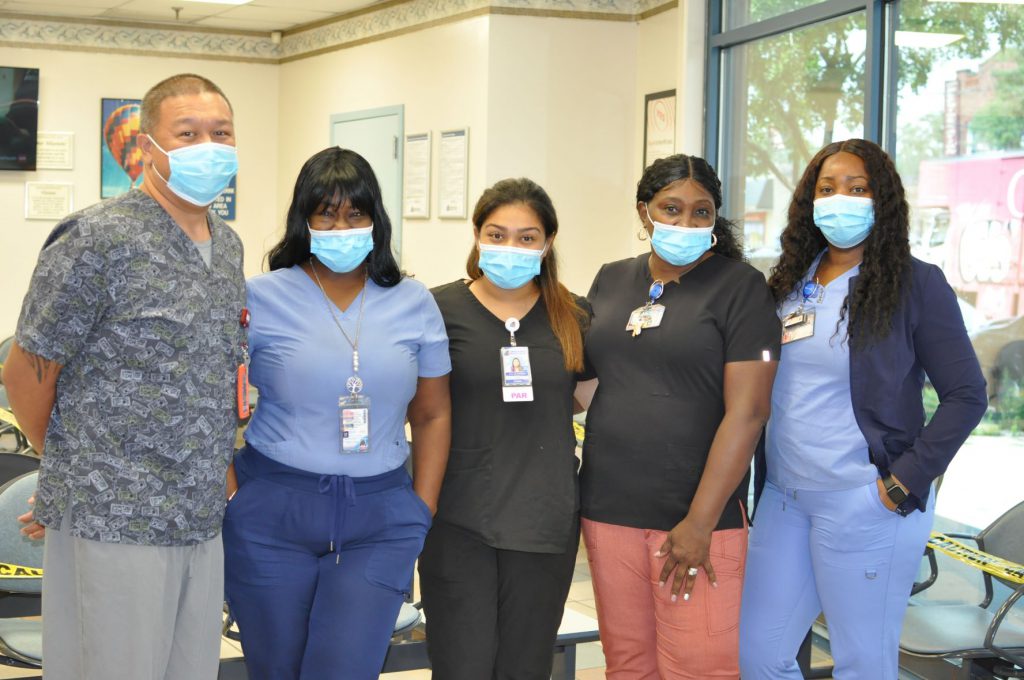
Should You Get a Flu Vaccine During the Pandemic?

Many people have asked whether or not they should get the flu shot during this year’s pandemic. According to medical experts, the answer is yes. There are a few very good reasons why getting a flu shot is the correct approach to protecting yourself. These include:

Getting influenza can weaken the body’s defenses and make it more susceptible to other illnesses, including Covid-19.

Since many of the symptoms of influenza and Covid-19 are similar, helping the body to fight off influenza can potentially make Covid-19 less severe.

Wearing a mask and social distancing have the potential to lessen our risk of contracting influenza as well as Covid-19, however these measures aren’t foolproof. A vaccine that will help lower the risk of getting seriously ill offers an added layer of protection..

Getting a flu vaccine during the pandemic may also help to prevent the spread of influenza to others.

It is possible to have the flu and Covid-19 at the same time; however, getting vaccinated can help lessen the severity of certain complications.

If you have any questions about getting one or both of these vaccines, consult with your physician to see if it is appropriate in your individual case. To schedule an appointment with a physician at Jamaica Hospital Medical Center, please call 718-206-7001

All content of this newsletter is intended for general information purposes only and is not intended or implied to be a substitute for professional medical advice, diagnosis or treatment. Please consult a medical professional before adopting any of the suggestions on this page. You must never disregard professional medical advice or delay seeking medical treatment based upon any content of this newsletter. PROMPTLY CONSULT YOUR PHYSICIAN OR CALL 911 IF YOU BELIEVE YOU HAVE A MEDICAL EMERGENCY.

COVID-19 Vaccine Fact Versus Myth

There are many myths being circulated about the COVID-19 vaccine due to a spread of misinformation. It is important to know what is true and what is not to help you make an informed decision about getting vaccinated.

Is it true that the vaccine was produced too quickly and is unsafe because it wasn’t tested sufficiently?

The vaccines have all been tested by the Food and Drug Administration and have been deemed to be safe.

All content of this newsletter is intended for general information purposes only and is not intended or implied to be a substitute for professional medical advice, diagnosis or treatment. Please consult a medical professional before adopting any of the suggestions on this page. You must never disregard professional medical advice or delay seeking medical treatment based upon any content of this newsletter. PROMPTLY CONSULT YOUR PHYSICIAN OR CALL 911 IF YOU BELIEVE YOU HAVE A MEDICAL EMERGENCY.
Home Workout Tips

When you’re starting a home workout program it can be hard to figure out what exercises you should perform, particularly if you don’t have the budget for pricey equipment or personal training.
Most experts will tell you that a home training program for fitness should target all your major muscle groups are targeted at least once each week. It is recommended that your program includes 30 to 60 minutes of moderate to vigorous aerobic exercise no more than three to five times a week.”
Most importantly, stretching should be a part of the workout regime. Stretching helps with both strength and flexibility.
Some proven home exercises that won’t break your piggy bank are:
• Squats. Standing upright, feet wider than shoulders apart. With your arms extended forward or your hands on your hips for balance, squat down. Push your knees outward as you descend until your thighs are parallel with the floor. Continue pushing your knees outward as you stand.
• Partial-body push-ups (with knees on the floor).
• Modified jumping jacks. Instead of moving your arms over your head, do these while you press the palms of your hands together at chest level, holding your elbows out to make a straight line.
• Chair crunches. Sit on a chair with your hands under your behind, arms straight, and fingers facing inward toward one another. Contract your pelvis and lower abs, and, keeping your knees bent at a 90-degree angle, lift your feet off the floor and tuck your knees in toward your chest while bending your upper body slightly toward your knees. Do as many as you can until you reach fatigue.
• Chair dips. Place your hands on the side of the chair and wrap your fingers around the edge. Scoot forward until your bottom is on the edge of the chair and your arms are fully extended. Keep your feet about 3 inches apart with your legs extended, so your knees are at approximately a 150 degree angle with your heels grounded. With your elbows pointed back and tucked in tight alongside your body, do 15 to 20 dips, 3 seconds down and 1 second up. Keep your chest up and your shoulders back.
It is important to speak with your Physician before beginning any exercise program, even if it is an at home program.

All content of this newsletter is intended for general information purposes only and is not intended or implied to be a substitute for professional medical advice, diagnosis or treatment. Please consult a medical professional before adopting any of the suggestions on this page. You must never disregard professional medical advice or delay seeking medical treatment based upon any content of this newsletter. PROMPTLY CONSULT YOUR PHYSICIAN OR CALL 911 IF YOU BELIEVE YOU HAVE A MEDICAL EMERGENCY.
Age-Related Macular Degeneration (AMD)

Age related Macular Degeneration (AMD) is the leading cause of severe vision loss in older adults. It affects approximately 10 million Americans – more than cataracts and glaucoma combined. With an aging U.S. population, that number is only expected to increase.

AMD occurs when the central portion of the retina, known as the macula, which is responsible for focusing central vision, deteriorates.

In its early stages, Macular Degeneration does not affect vision, but as the disease progresses, people may experience wavy or blurred vision or blurred spot in the center of their vision. If the condition continues to worsen, central vision may be completely lost.

Advanced stages of AMD can affect one’s ability to read, drive a car, watch television, or perform many visual tasks. In fact, those living with AMD are considered legally blind.

There are two types of macular degeneration; dry and wet.

  • Dry AMD is an early stage of the disease. Approximately 85% to 90% of AMD cases are the dry type. Dry Macular Degeneration is diagnosed when yellowish spots known as drusen begin to accumulate in and around the macula. It is believed that these spots are deposits or debris from deteriorating tissue. A few small drusen may not cause changes in vision; however, as they grow in size and increase in number, they may lead to a dimming or distortion of vision that people find most noticeable when they read.
  • Approximately 10 percent of the cases of dry AMD progresses to the more advanced and damaging form of the disease known as wet AMD. During this phase, new blood vessels grow beneath the retina and leak blood and fluid. This leakage causes permanent damage to light-sensitive retinal cells, resulting in distorted vision including the appearance of wavy lines, as well as blind spots and loss of central vision. These abnormal blood vessels and their bleeding eventually form a scar, leading to permanent loss of central vision.

As the name implies, the biggest risk factor for AMD is age as the disease is most prevalent in those 55 and older. Another known link to AMD is smoking as it is believed to double the risk of developing the disease. AMD is most common in Caucasians and in females. People with a family history of AMD are also believed to be at a higher risk. Hypertension and obesity are also considered risk factors for Macular Degeneration by some, although there is no conclusive research linking these factors.

There is no cure for AMD, but if detected early, there are medical treatment and lifestyle changes that can delay the progression of the disease. Macular degeneration may not present any symptoms in the early stages and it may be unrecognized until it progresses. For this reason, it is important for older adults to monitor their eye site and visit their eye doctor regularly. Eye care doctors can often detect early signs of Macular Degeneration before symptoms occur. Usually this is accomplished through a retinal exam.

Jamaica Hospital’s Ophthalmology Center can diagnose and treat a wide variety of eye disorders. To make an appointment, please call 718-206-5900.

All content of this newsletter is intended for general information purposes only and is not intended or implied to be a substitute for professional medical advice, diagnosis or treatment. Please consult a medical professional before adopting any of the suggestions on this page. You must never disregard professional medical advice or delay seeking medical treatment based upon any content of this newsletter. PROMPTLY CONSULT YOUR PHYSICIAN OR CALL 911 IF YOU BELIEVE YOU HAVE A MEDICAL EMERGENCY.

This Month We Shine Our Employee Spotlight on Navindra Santram, E.M.T.

This month we are proud to shine our Employee Spotlight on Navindra “Navie” Santram an Emergency Medical Technician in our Pre-Hospital Care Department.

Navindra, or as he likes to be called Navie is a native of Guyana who came to the United States when he was 6 years old. He has lived in Richmond Hill and Ozone Park, attended PS 226, is a 1992 graduate of Hillcrest High School and attended LaGuardia College. He continues to live in Queens with his wife and two sons who are 11 and 12 years of age.  Also living in his home are his 2 ½ year old puppy and an assortment of tropical fish. Family is very important to Navie and he enjoys spending his free time with them whether it be playing sports, board games, or traveling to new destinations. Whenever he and his family go on vacation to places they have never been, they like to learn as much as possible about the area they are visiting. This includes the history, the culture, and the food people eat there. Another one of his favorite activities is camping. He likes being outdoors and enjoying nature.

Navie enjoys many types of food, especially Caribbean, and Italian. He has a deep knowledge of all genres of music particularly music from the Golden ’60s. He and his family enjoy watching action movies together. He also enjoys planting vegetables in his garden and watching them grow.

Working at Jamaica Hospital Medical Center for the past 14 ½ years has given Navie the opportunity to pursue his passion for helping others, especially those who find themselves in need of medical attention. He greatly appreciates all the opportunities he has been given to grow professionally and he feels fortunate to be working with people who are passionate about the work that they do for people in the community. In 2017 Jamaica Hospital sent a team of medical professionals to Puerto Rico to help in the Hurricane Maria Relief effort and Navindra feels fortunate to have been selected to be a part of this medical mission. Helping people whose lives were devastated was a very rewarding experience, and one that he will never forget.

We are fortunate to have Navie working for us and we look forward to having him as a member of our team for many more years to come.

All content of this newsletter is intended for general information purposes only and is not intended or implied to be a substitute for professional medical advice, diagnosis or treatment. Please consult a medical professional before adopting any of the suggestions on this page. You must never disregard professional medical advice or delay seeking medical treatment based upon any content of this newsletter. PROMPTLY CONSULT YOUR PHYSICIAN OR CALL 911 IF YOU BELIEVE YOU HAVE A MEDICAL EMERGENCY.