Cataract Awareness Month

June is Cataract Awareness Month, a month to educate the public on an eye disease that is the leading cause of vision loss in the United States and the world’s leading cause of blindness.  

Most cataracts occur when aging or injury changes the tissue that makes up the eye’s lens, and proteins and fibers in the lens begin to break down, causing it to become cloudy. Most cataracts develop slowly and don’t disturb eyesight early on, but with time, they will eventually affect a person’s vision.  

There are several symptoms of cataracts, including: 

  • Clouded, blurred, or dim vision 
  • Trouble seeing at night 
  • Sensitivity to bright light and glare 
  • The need for brighter light for reading and other activities 
  • Seeing “halos” or streaks that form around lights 
  • Frequent changes in eyeglass or contact lens prescription 
  • Fading or yellowing of colors 
  • Double vision in one eye 

There are many types of cataracts, including: 

  • Nuclear cataracts 
  • Cortical cataracts 
  • Posterior subcapsular cataracts 
  • Congenital cataracts 

Several factors can increase the risk of cataracts, including: 

  • Increasing age 
  • Diabetes 
  • Getting too much sunlight 
  • Smoking 
  • Obesity 
  • Family history of cataracts 
  • Previous eye injury or inflammation 
  • Prolonged use of corticosteroid medicines 
  • Drinking excessive amounts of alcohol 

Ophthalmologists and optometrists diagnose cataracts through a comprehensive eye exam. A healthcare provider will closely examine your eyes for signs of cataracts and assess their severity. They will also ask about your vision, medical history, and if you’re having trouble with everyday tasks because you can’t see as well as before. Tests used to diagnose cataracts include: 

  • Slit lamp exam 
  • Visual acuity test 

Cataract surgery is the only way to remove cataracts and restore clear vision. During this surgery, an ophthalmologist removes the clouded natural lens and replaces it with an intraocular lens (IOL). An IOL is an artificial lens that permanently stays in the eye.  

No studies have proven how to prevent or slow the growth of cataracts. However, healthcare professionals think several strategies may be helpful, including: 

  • Getting regular eye exams 
  • Quitting smoking 
  • Managing other health problems 
  • Choosing a healthy diet that includes plenty of fruits and vegetables 
  • Wearing sunglasses 
  • Reducing alcohol use 

If you’re experiencing cataract symptoms, you can schedule an appointment at Jamaica Hospital Medical Center’s Ophthalmology Center by calling (718) 206-5900. 


All content of this newsletter is intended for general information purposes only and is not intended or implied to be a substitute for professional medical advice, diagnosis or treatment. Please consult a medical professional before adopting any of the suggestions on this page. You must never disregard professional medical advice or delay seeking medical treatment based upon any content of this newsletter. PROMPTLY CONSULT YOUR PHYSICIAN OR CALL 911 IF YOU BELIEVE YOU HAVE A MEDICAL EMERGENCY.
June is Cataract Awareness Month

The American Academy of Ophthalmology has designated June as Cataract Awareness Month. The purpose of this designation is to help educate the public on what cataracts are and how to treat them once they are diagnosed.
Cataracts are a clouding of the lens of the eye. This will result in blurry vision, and since less light is being transmitted, objects will appear darker as well.
It is estimated that 25 million people in the United States age 40 and older will be diagnosed with a cataract, and by the time people reach the age of 80, more than half of the population of the United States will be affected with the disease.
Risk factors for developing cataracts include:
• Age
• Diabetes
• Smoking
• Prolonged exposure to sunlight
• Obesity
• High blood pressure
• Hereditary factors
• Prior eye injuries
Cataracts are classified by what causes them. Age is the biggest factor, followed by eye trauma, congenital causes and secondary to taking certain medications like steroids.
There are a few ways to lower the risk of developing cataracts, but they may not be completely successful.
Wearing sunglasses when outdoors
A diet rich in vitamin C foods
Avoiding smoking
Treatment for cataracts involves a surgical procedure which removes the old lens of the eye  and replacing it with a synthetic one. It is a very common procedure and considered relatively safe. If you would like to schedule an appointment with an eye doctor at Jamaica Hospital, please call 718-206-5900.

All content of this newsletter is intended for general information purposes only and is not intended or implied to be a substitute for professional medical advice, diagnosis or treatment. Please consult a medical professional before adopting any of the suggestions on this page. You must never disregard professional medical advice or delay seeking medical treatment based upon any content of this newsletter. PROMPTLY CONSULT YOUR PHYSICIAN OR CALL 911 IF YOU BELIEVE YOU HAVE A MEDICAL EMERGENCY.

Are You at Risk for Developing Cataracts?

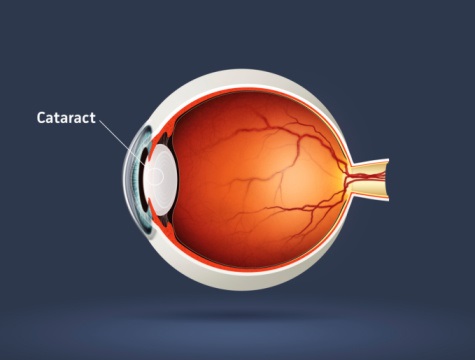
High quality raster illustration of cataract (eye disease)Cataracts are the leading cause of blindness globally.  They are very common in older adults- in fact; it is estimated that more than 75% of people over the age of 65 will develop cataracts.  Although less common, people can develop this medical condition in their forties and fifties as well.

As you age, proteins in the eye begin to break down, causing clouding in the lens and the formation of cataracts. Many who are affected are unaware that this process is occurring because cataracts grow very slowly and does not impede vision during its early stages.   There are symptoms that can indicate the development of cataracts. Here are some that you can look out for:

  • Colors appear faded
  • Clarity in vision decreases and cannot be corrected with eyeglasses
  • An increase in sensitivity to light and glare
  • Halos appearing around lights
  • Poor night vision
  • Frequent changes in prescription eyewear
  • Double vision

Some people are more at risk of developing cataracts than others. These factors increase your risks:

  • Diabetes
  • Exposure to prolonged durations of sunlight
  • Heavy drinking
  • Smoking
  • Obesity
  • Family history
  • Advanced age
  • High blood pressure
  • Previous eye injury or surgery

June is Cataract Awareness Month. During this time, the Department of Ophthalmology at Jamaica Hospital Medical Center wants you to know, there are several things you can do to be proactive and slow the progression of cataracts.  Eating healthy is a good start. A balanced diet rich in vitamin C has shown to be effective.  Wear sunglasses to shield your eyes from the Sun’s UV rays.  If you are a smoker- stop smoking and drink in moderation.  Early detection can save your eyesight therefore, scheduling routine eye exams is very important.

To schedule an appointment with an ophthalmologist (eye doctor) at Jamaica Hospital, please call, 718-206-5900.

All content of this newsletter is intended for general information purposes only and is not intended or implied to be a substitute for professional medical advice, diagnosis or treatment. Please consult a medical professional before adopting any of the suggestions on this page. You must never disregard professional medical advice or delay seeking medical treatment based upon any content of this newsletter. PROMPTLY CONSULT YOUR PHYSICIAN OR CALL 911 IF YOU BELIEVE YOU HAVE A MEDICAL EMERGENCY.