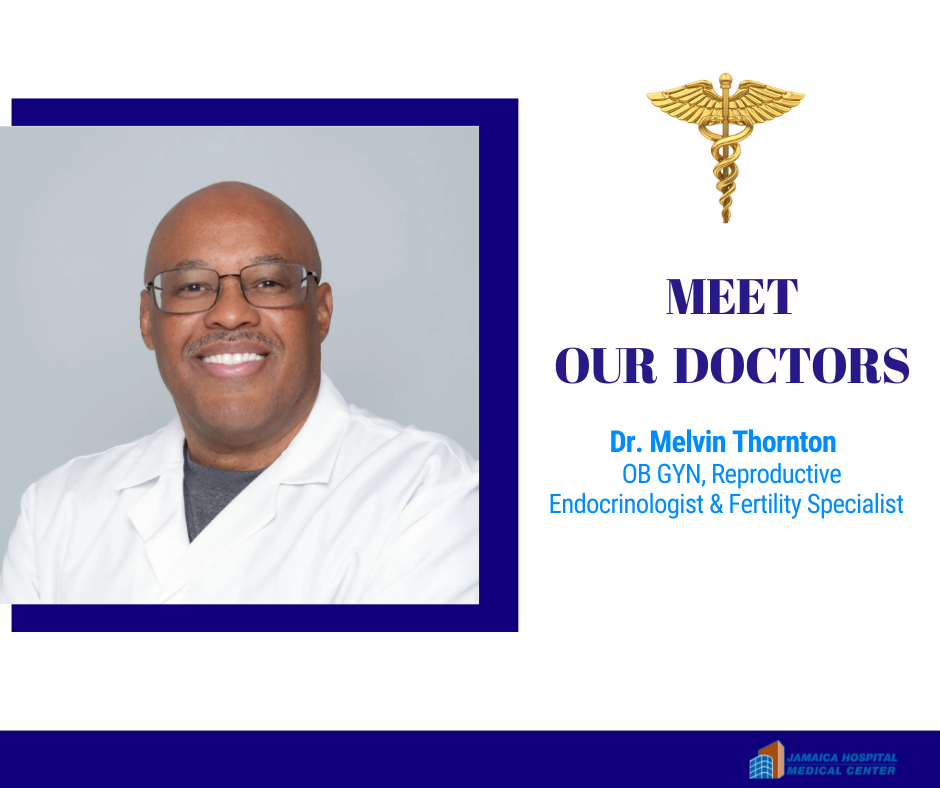
Meet Our Doctors- Dr. Melvin Thornton II

We are pleased to introduce Dr. Melvin Thornton II, the newest member of the Obstetrics and Gynecology team at Jamaica Hospital Medical Center. 

Dr. Thornton specializes in infertility, obstetrics and gynecology, and reproductive endocrinology. He chose this career path because, “in medical school I helped deliver my first baby and it was the most amazing thing in the world, and I will always remember that day. Then I realized that many couples could not experience the joy of having children, so I decided to dedicate my life and career to helping families have children,” he explained.  

Born in Cleveland, Ohio, Dr. Thornton attended Oberlin College for his undergraduate degree and Washington University in St. Louis for medical school. He completed his residency in obstetrics and gynecology and reproductive endocrinology and infertility fellowships at the University of Southern California and L.A. County Hospital, where he was board-certified in both. He also completed his pelvic surgery fellowship at The Cleveland Clinic. Dr. Thornton treats female and male infertility, and female reproductive hormonal disorders, such as polycystic ovarian syndrome, prolactin, and menstrual disorders.  

Recognized as one of the world’s leading experts in egg donation and surrogacy, Dr. Thornton has been helping families achieve their dreams for over 30 years and is excited to join the Jamaica Hospital team and practice in the community because he wants to help couples in the Queens area who are having difficulty conceiving. He is bringing his expertise in diagnosing and treating men and women to help them have children, as well as the opportunity for women to undergo fertility preservation, particularly for those diagnosed with cancer before undergoing cancer treatment. 

Dr. Thornton has distinguished himself in the treatment of HIV serodiscordant couples and the relationship to infertility and fertility treatment through his extensive research. He has published more than 50 papers, written several book chapters, and presented over 100 abstracts at national conferences on topics related to infertility, third-party reproduction, and women’s health. He is an excellent educator and gives board review lectures for OB/GYN, Family Medicine, and Pediatrics residents preparing for their board examination. 

Dr. Thornton currently lives in Central Valley, Orange County, New York, and is proud to practice in Queens. He joined the faculty at Columbia University, where he served as Medical Director and Director of the Egg Donation Program at the Center for Women’s Reproductive Care (CWRC). He previously was a member of the Accreditation Council for Graduate Medical Education (ACGME) Clinical Competency Committee for Obstetrics and Gynecology at Columbia University and currently sits on the American Society for Reproductive Medicine (ASRM) Education Committee and a member of the newly formed ASRM Diversity, Equity, and Inclusion Taskforce, which will enhance opportunities in reproductive medicine for underrepresented minority populations and reduce health disparities and access to care. 

Dr. Thornton is a Castle Connolly National Top Doctor and was awarded the Top Doctor’s New York Metro Area Award in 2017, 2018, 2019, 2020-2026. 

We are proud to welcome Dr. Thornton to our team and look forward to the work he and the rest of the Department of Obstetrics and Gynecology will provide high-quality care to our community.   

Jamaica Hospital’s Department of Women’s Health Services provides a comprehensive range of inpatient and outpatient OB/GYN services to women in our community. You can schedule an appointment with an OB/GYN at Jamaica Hospital Medical Center’s Women’s Health Center. To learn more, please call (718) 291-3276. 

All content of this newsletter is intended for general information purposes only and is not intended or implied to be a substitute for professional medical advice, diagnosis or treatment. Please consult a medical professional before adopting any of the suggestions on this page. You must never disregard professional medical advice or delay seeking medical treatment based upon any content of this newsletter. PROMPTLY CONSULT YOUR PHYSICIAN OR CALL 911 IF YOU BELIEVE YOU HAVE A MEDICAL EMERGENCY.
National Infertility Awareness Week

April 19th to April 25th is observed as Infertility Awareness Week, a week dedicated to breaking the stigma around infertility, amplifying the stories of those who have and are experiencing infertility, and advocating for equitable access to care to help treat it. 

Infertility is the condition that causes the inability to get pregnant after one year of trying to conceive. 

The World Health Organization (WHO) estimates that roughly one in six people worldwide is affected by infertility. 

Infertility may happen because of a health issue with either you or your partner, or a mix of factors that prevent pregnancy. However, many safe and effective treatments can boost your chances of getting pregnant.  

The main symptom of infertility is not getting pregnant. There may be no other clear symptoms. Some women with infertility may have irregular menstrual periods or no periods. Some men may have some symptoms of hormonal problems, such as changes in hair growth or sexual function.  

Many couples will conceive eventually with or without treatment.  

Women should talk with a healthcare professional about infertility if they have been trying to get pregnant for at least a year. Sooner if they: 

  • Are 35 years or older and have tried to conceive for six months or longer 
  • Are over the age of 40 
  • Have had no periods or irregular or very painful periods 
  • Have known fertility problems 
  • Have endometriosis or a history of pelvic inflammatory diseases 
  • Have had one or more miscarriages  
  • Have received cancer treatment such as chemotherapy or radiation 

Men should talk to a healthcare professional if they have: 

  • A low number of sperm or other problems with sperm 
  • A history of testicular, prostate, or sexual conditions 
  • Had treatment for cancer, such as chemotherapy 
  • Had hernia surgery 
  • Testicles that are smaller than the typical adult size, or swollen veins in the scrotum 
  • Had infertility with a partner in the past 
  • Relatives with infertility problems 

Sometimes, the issues that cause infertility in couples are present at birth. Other times, they develop in life.  

Infertility can affect one or both partners. In some cases, no cause can be found. Some causes of male infertility can include: 

  • Conditions that can affect how much sperm is made or sperm quality 
  • Problems with sperm reaching the female reproductive tract 
  • Certain environmental factors 
  • Damage related to cancer and its treatment 

Some causes of female infertility can include: 

  • Ovulation disorders 
  • Uterine conditions 
  • Fallopian tube damage or blockage 
  • Endometriosis 
  • Primary ovarian insufficiency 
  • Pelvic adhesions 
  • Cancer and its treatments 

Many risk factors for both male and female infertility are the same. They include: 

  • Age 
  • Tobacco use 
  • Marijuana use 
  • Alcohol use 
  • Being overweight or underweight 
  • Exercise issues 

Some types of infertility cannot be prevented. However, the following tips may boost your chances of pregnancy: 

  • Couples should have sex often and soon after menstrual bleeding stops. One of the ovaries usually releases an egg in the middle of the cycle, which is midway between menstrual periods, for most people with menstrual cycles, that is about 28 days apart. It is ideal to have sex every day, starting five to seven days before an egg is released. Continue until two days after ovulation.  
  • Before you are tested for infertility, your healthcare team or clinic will work to understand your sexual habits. They might make recommendations to improve your chances of getting pregnant. Unfortunately, for some couples, no cause for infertility is found. This is called unexplained fertility.  

Men’s treatment for infertility may include: 

  • Lifestyle changes 
  • Medicines 
  • Surgery 
  • Sperm retrieval procedures 

Some women need only one or two treatments to improve infertility. Others may need a few types of therapies to become pregnant, including: 

  • Fertility medicines 
  • Intrauterine insemination (IUI) 
  • Surgery to restore fertility 

Assisted reproductive technology (ART) is also used. In vitro fertilization (IVF) is the most common ART technique.  

At Jamaica Hospital’s Department of Women’s Health Services, we are passionate about meeting the various needs of women in our community. We proudly treat women from all walks of life and provide a warm and welcoming environment. To learn more about our OB/GYN services or to make an appointment, contact us at 718-291-3276. 

All content of this newsletter is intended for general information purposes only and is not intended or implied to be a substitute for professional medical advice, diagnosis or treatment. Please consult a medical professional before adopting any of the suggestions on this page. You must never disregard professional medical advice or delay seeking medical treatment based upon any content of this newsletter. PROMPTLY CONSULT YOUR PHYSICIAN OR CALL 911 IF YOU BELIEVE YOU HAVE A MEDICAL EMERGENCY.

The Facts About Male Infertility

Infertility is a diagnosis given to couples who have been unsuccessful at conceiving after a year of trying. Infertility affects approximately 15% of all couples and within this group male infertility issues contribute to 30% of all cases.

During Men’s Health Month, Jamaica Hospital wants to provide information about male infertility and offer treatment options for those trying to conceive.


The most common cause of male infertility is a varicocele, which is an enlargement of the veins within the scrotum that holds the testicles. Varicoceles are a common cause of low sperm production and decreased sperm quality.

Other causes include:

  • Age
  • A blockage in your reproductive system
  • Undescended testicles
  • Sperm that are abnormally shaped or that don’t move correctly
  • Hormone problems
  • Certain health conditions, such as cancer
  • An infection or sexually transmitted disease (STD)
  • Erectile dysfunction.

Sometimes the cause of male infertility is unknown. In these cases, it may be the result of genetics, lifestyle, or environmental factors.

A doctor can help find the cause of infertility. Your doctor will do an exam and review your medical history. A semen analysis will determine sperm count and quality. Another test your doctor may perform is a check of your hormone levels.

While you cannot always prevent male infertility, there are factors that can affect this condition that should be avoided. These include:

  • smoking
  • alcohol or drug abuse
  • emotional stress
  • obesity
  • Frequent hot tub use or wearing tight fitting underwear.

More than half of male infertility cases can be corrected. Treatment options depend on the root cause. Medicine can improve hormone levels or erectile dysfunction. Surgery can help correct physical problems, such as a varicocele. It also can repair blockages or other damage. Surgery is often minor and done as an outpatient procedure.

In cases where infertility cannot be cured, your doctor may suggest a form of assisted reproductive therapy, such as:

  • Intrauterine insemination (IUI). A man’s sperm is collected and inserted into the woman’s uterus. This procedure is done at the time of ovulation.
  • In vitro fertilization (IVF). This technique is more complex. A man’s sperm and a woman’s egg are fertilized in the lab. Then it is implanted back in the woman’s uterus.

All content of this newsletter is intended for general information purposes only and is not intended or implied to be a substitute for professional medical advice, diagnosis or treatment. Please consult a medical professional before adopting any of the suggestions on this page. You must never disregard professional medical advice or delay seeking medical treatment based upon any content of this newsletter. PROMPTLY CONSULT YOUR PHYSICIAN OR CALL 911 IF YOU BELIEVE YOU HAVE A MEDICAL EMERGENCY.