Thyroid Awareness Month

January is Thyroid Awareness Month, a month that observes the importance of raising awareness of thyroid disorders and how they affect the lives of millions of people around the world.  

The thyroid is a gland located in front of the neck. It is a part of the body’s endocrine system and produces hormones that play an important role in many of the body’s systems, such as cells and tissues, the heart, brain, liver, and kidneys.  

The hormones the thyroid produces include: 

  • Thyroxine (T4)- the primary hormone made and released by the thyroid. It is the hormone that the thyroid makes the most of; however, it doesn’t have much of an effect on the metabolism 
  • Triiodothyronine (T3)- the thyroid makes lesser amounts of this hormone, but it has a much bigger impact on the metabolism than T4 
  • Reverse triiodothyronine- the thyroid makes very small amounts of RT3. This hormone reverses the effects of T3 
  • Calcitonin- this hormone helps regulate the amount of calcium in the blood 

These hormones also affect several bodily functions, including: 

  • Blood pressure 
  • Body temperature 
  • Heart rate 
  • Metabolism 
  • Breathing 
  • Digestion 
  • Brain development 
  • Mental activity 
  • Skin and bone maintenance 
  • Fertility 

Four main conditions affect the thyroid, including: 

  • Hypothyroidism, which is an underactive thyroid gland 
  • Hyperthyroidism, which is an overactive thyroid gland 
  • Goiter, which is an enlarged thyroid gland 
  • Thyroid cancer 

Different thyroid conditions have different symptoms. Symptoms depend on whether the thyroid is under- or over-producing hormones and can often be silent or present symptoms that are overlooked due to their subtlety.  

Symptoms that may signal a thyroid condition include: 

  • Slow or rapid heart rate 
  • Unexplained weight loss or weight gain 
  • Difficulty tolerating the cold or heat 
  • Depression (caused by hypothyroidism) or anxiety (caused by hyperthyroidism) 
  • Irregular menstrual periods 

When a healthcare provider wants to check the health of a person’s thyroid, they perform a blood test that measures the levels of thyroid-stimulating hormone (TSH). They will also check the levels of T4 and T3 in the blood. If the results of these tests come back and are abnormal, the healthcare provider may suggest an imaging test such as a thyroid scan or an ultrasound of the thyroid.  

There are several treatment options for thyroid conditions, depending on what they are and their severity. The three main treatment options for thyroid conditions include: 

  • Medication 
  • Surgery 
  • Radiation therapy and chemotherapy 

Thyroid conditions are common and can affect anyone at any age. However, some people face a higher risk if they: 

  • Have a family history of thyroid disease 
  • Have an autoimmune condition, such as type 1 diabetes, rheumatoid arthritis, or lupus 
  • Take a medication that’s high in iodine 
  • Are older than 60, especially if you’re female 

Fortunately, there is a way for a person to keep their thyroid healthy. This can be done by getting enough iodine in their diet with foods that are fortified with iodine, such as cheese, cow milk, eggs, yogurt, saltwater fish, shellfish, seaweed, soy milk, and soy sauce. 

If you would like to get your thyroid checked or to receive more information about Jamaica Hospital’s endocrinology service, you can make an appointment by calling 718-206-7001. 


All content of this newsletter is intended for general information purposes only and is not intended or implied to be a substitute for professional medical advice, diagnosis or treatment. Please consult a medical professional before adopting any of the suggestions on this page. You must never disregard professional medical advice or delay seeking medical treatment based upon any content of this newsletter. PROMPTLY CONSULT YOUR PHYSICIAN OR CALL 911 IF YOU BELIEVE YOU HAVE A MEDICAL EMERGENCY.

Endocrine disruptors

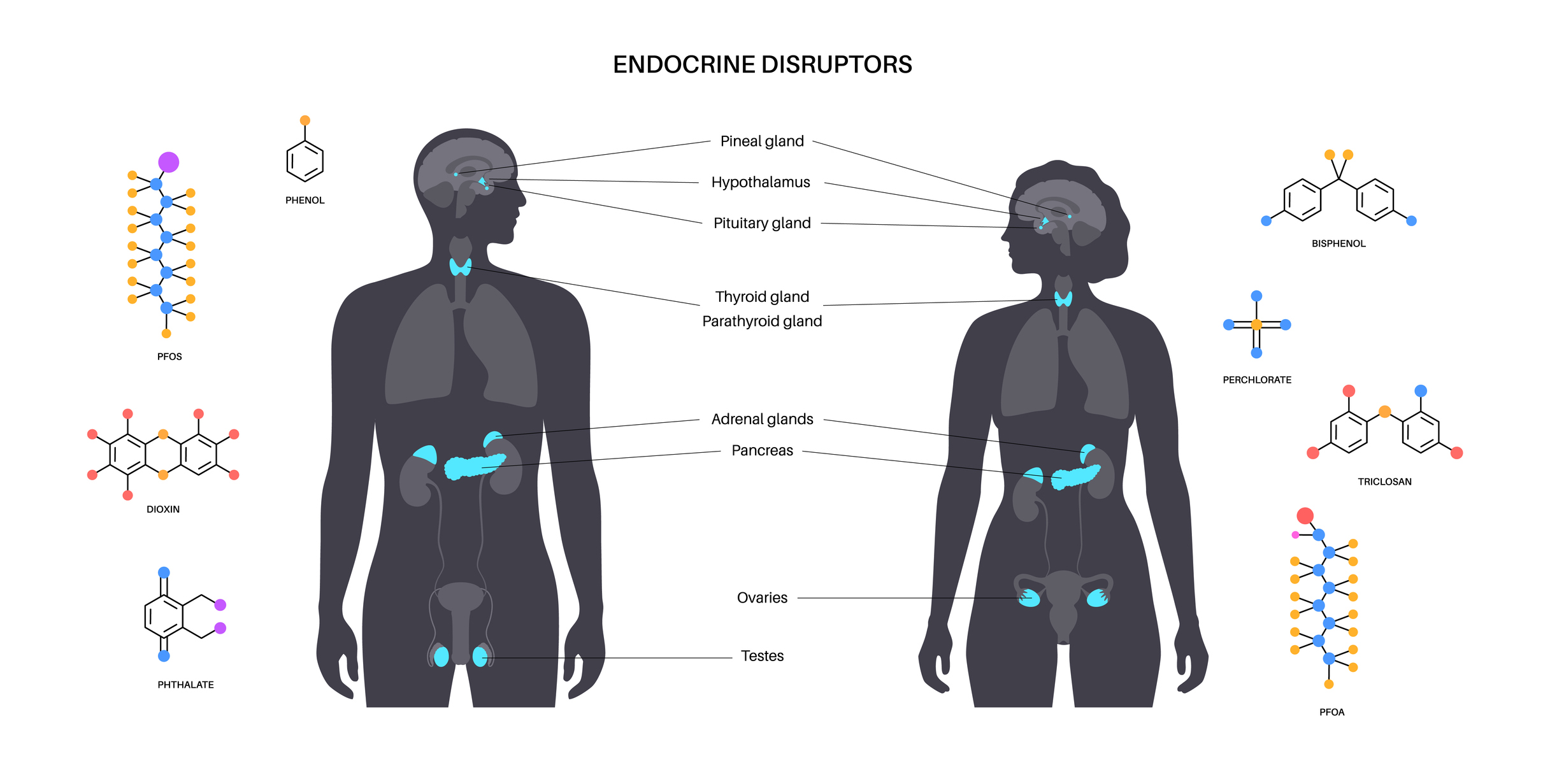
Endocrine disruptors are natural or man-made chemicals that may mimic or interfere with how the body’s hormones, which are part of the endocrine system, work. The endocrine system is a network of glands and organs that produce, store, and secrete hormones. These chemicals are linked to many health problems in both wildlife and people. Since endocrine-disrupting chemicals (EDCs) come from many different sources, people are exposed in several ways, including the air we breathe, the food we eat, and the water we drink. EDCs can also enter the body through the skin.

Endocrine disruptors can disrupt many different hormones, which is why they have been linked to numerous adverse human health outcomes, including:

  • Alterations in sperm quality and fertility
  • Abnormalities in sex organs
  • Endometriosis
  • Early puberty
  • Altered nervous system function
  • Immune function
  • Certain cancers
  • Respiratory and cardiovascular problems
  • Metabolic issues
  • Diabetes
  • Obesity
  • Growth
  • Neurological and learning disabilities

According to the Endocrine Society, there are nearly 85,000 human-made chemicals worldwide, and 1,000 or more of those could be endocrine disruptors based on their unique properties. The following chemicals are among the most common and well-studied:

  • Atrazine
  • Bisphenol A (BPA)
  • Dioxins
  • Perchlorate
  • Per- and poly-fluoroalkyl substances (PFAS)
  • Phthalates
  • Phytoestrogens
  • Polybrominated diphenyl ethers (PBDE)
  • Polychlorinated biphenyls (PCBs)
  • Triclosan

High EDC exposures during fetal development and childhood can have long-lasting health effects since there are periods where hormones regulate the formation and maturation of organs. Early-life exposures have been linked to developmental abnormalities and may increase the risk for various diseases later in life.

Many EDCs have been found to cross the placenta and become concentrated in the fetus’ circulatory system. Other EDCs can be transferred from mother to infant through breast milk.

Although evidence linking EDCs to adverse health outcomes grows, the cause-and-effect relationship is not yet fully understood. Generally, chronic high exposure poses the highest risk, however, a developing fetus or infant is more vulnerable to lower exposures.

Additionally, a person’s genetic predisposition to specific health conditions and additional environmental risk factors can modify how a person is affected by EDCs.

For more information about Jamaica Hospital’s endocrinology service, or to make an appointment, please call 718-206-7001.


All content of this newsletter is intended for general information purposes only and is not intended or implied to be a substitute for professional medical advice, diagnosis or treatment. Please consult a medical professional before adopting any of the suggestions on this page. You must never disregard professional medical advice or delay seeking medical treatment based upon any content of this newsletter. PROMPTLY CONSULT YOUR PHYSICIAN OR CALL 911 IF YOU BELIEVE YOU HAVE A MEDICAL EMERGENCY.

What is Hashimoto’s Disease?

A doctor examining a woman's thyroid gland to check for signs of Hashimoto's disease.Hashimoto’s disease is an autoimmune condition that causes your thyroid gland to become enlarged (also known as goiter) and become underactive (also known as hypothyroidism). These symptoms may not appear at first, and in some people they may not develop at all, but they can occur gradually and lead to a variety of other issues, such as fatigue, weight gain, a slowed heart rate, difficulty concentrating, or a low mood.

Approximately 5% of people in the United States experience Hashimoto’s disease. It is one of the most common causes of hypothyroidism worldwide, aside from iodine deficiency. While it can affect people of any age, sex, or ethnic background, it is much more common among people assigned female at birth (AFAB) than people assigned male at birth (AMAB). It is also typically diagnosed between the ages of 30 and 50.

A person develops Hashimoto’s disease when their immune system creates antibodies to attack thyroid tissue. This causes thyroid inflammation and damage due to an accumulation of white blood cells in your thyroid. People with other autoimmune conditions, such as lupus, celiac disease, type 1 diabetes, or rheumatoid arthritis, are more likely to develop Hashimoto’s disease than people who do not experience these conditions.

Your doctor can diagnose Hashimoto’s disease through a physical examination, a review of your medical history, and blood tests. Specific tests that help with this diagnosis include a thyroid-stimulating hormone test (which is typically used to check for hypothyroidism) and an antithyroid antibody test (which looks for certain types of antibodies in your blood to determine whether Hashimoto’s disease is the cause of your hypothyroidism).

Hashimoto’s disease cannot be cured, but in cases where it causes hypothyroidism, it can often be managed through medication. The standard treatment is levothyroxine, which supplements the hormone thyroxine (T4) and ensures that your body has enough of it to function normally. While you would need to take this medication for the rest of your life, it is effective at managing the symptoms of this condition for most people.

If you are experiencing symptoms of Hashimoto’s disease and require a diagnosis or treatment, you can schedule an appointment at Jamaica Hospital Medical Center’s Ambulatory Care Center by calling (718) 670-7001.

All content of this newsletter is intended for general information purposes only and is not intended or implied to be a substitute for professional medical advice, diagnosis or treatment. Please consult a medical professional before adopting any of the suggestions on this page. You must never disregard professional medical advice or delay seeking medical treatment based upon any content of this newsletter. PROMPTLY CONSULT YOUR PHYSICIAN OR CALL 911 IF YOU BELIEVE YOU HAVE A MEDICAL EMERGENCY.