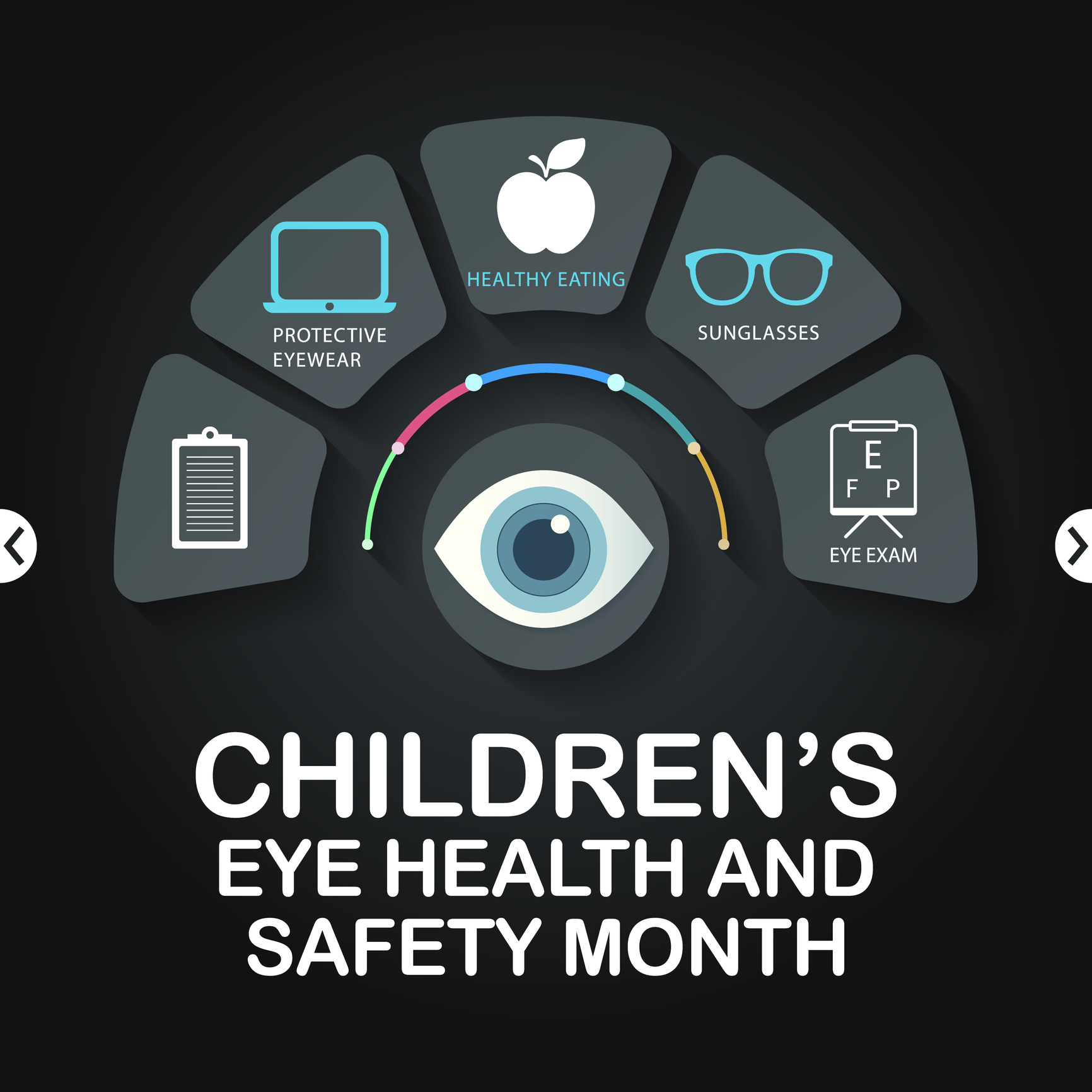
Children’s Eye Health and Safety Month

August is Children’s Eye Health and Safety Month. As many parents prepare their children for the new school year, it is essential to have their eyes checked.  

Vision is a vital part of a child’s development. It is how they learn, play, and interact with the world around them. Uncorrected vision problems can impair child development, interfere with learning, and even lead to permanent vision loss.  

Unfortunately, many eye problems in children go undetected, which can lead to long-term issues. Regular eye exams are crucial in identifying problems early, ensuring your child has the best chance for healthy vision. Good vision is essential for their performance in school, in sports, and for their overall well-being. 

Vision issues in children are common in the United States. They are vulnerable to many eye problems, including: 

  • Injuries 
  • Infections 
  • Nearsightedness 

There are many things to be aware of that may indicate a problem with your child’s eyes, including: 

  • Their eyes do not line up or appear crossed 
  • Their eyelids are red-rimmed, crusted, or swollen 
  • Their eyes are watery or inflamed 
  • They rub their eyes a lot 
  • They close or cover one eye 
  • They tilt their head forward 
  • They have trouble reading or doing other close-up work  
  • They hold objects close to their eyes to see 
  • They blink more than usual or seem cranky when doing close-up work 
  • Things are blurry or hard to see for them 

There are many ways to protect your child’s eye health, including: 

  • Getting regular eye exams 
  • Wearing protective eyewear during sports and other activities 
  • Limiting screen time 
  • Practicing healthy nutrition 

If you would like to schedule an eye exam for your child, you can visit an ophthalmologist at Jamaica Hospital Medical Center. To schedule an appointment, please call (718) 206-5900. 


All content of this newsletter is intended for general information purposes only and is not intended or implied to be a substitute for professional medical advice, diagnosis or treatment. Please consult a medical professional before adopting any of the suggestions on this page. You must never disregard professional medical advice or delay seeking medical treatment based upon any content of this newsletter. PROMPTLY CONSULT YOUR PHYSICIAN OR CALL 911 IF YOU BELIEVE YOU HAVE A MEDICAL EMERGENCY.

Children’s Eye Health and Safety Month

This August is Children’s Eye Health and Safety Month, a time to learn more about some of the most common problems affecting children’s vision and ways to prevent and treat those conditions.

According to the CDC, about 1 in every 4 children in the United States suffers from an undiagnosed eye health problem. These issues come in a wide variety of different forms, but some are more frequent than others, including:

Strabismus: This condition causes crossed eyes, preventing both eyes from focusing on the same object.

Amblyopia: Also known as “lazy eye,” amblyopia disrupts communication between the brain and the affected eye, leading to a greater reliance on the stronger eye and deteriorating vision in the affected eye.

Blurred vision: This issue can result from a few different conditions, including refractive errors like myopia (nearsightedness), hyperopia (farsightedness), or astigmatism (a misshapen cornea). Convergence insufficiency can also blur your child’s vision when looking at an object up close.

Binocular vision dysfunction (BVD): This problem occurs when your child’s eyes are misaligned and failing to work together, leading to symptoms like double vision and light sensitivity.

Nystagmus: As many as 1 in 1,000 school-aged children suffer from nystagmus, which causes uncontrollable eye movements that may lead to dizziness, balance problems, and shaky vision.

You can prevent these problems from negatively impacting your child’s quality of life in a few different ways, including getting recommended vision screenings during your child’s regular checkups with a pediatrician or other healthcare professional.

If any signs of an eye health issue are found during a vision screening, an eye exam by an ophthalmologist or optometrist can more accurately diagnose the cause of that problem and help create an effective treatment plan. Protective eyewear, adequate sleep, and limited screen time also go a long way toward preserving your child’s eye health.

To schedule an appointment at Jamaica Hospital Medical Center’s Ophthalmology Department, please call 718-206-5900.

All content of this newsletter is intended for general information purposes only and is not intended or implied to be a substitute for professional medical advice, diagnosis or treatment. Please consult a medical professional before adopting any of the suggestions on this page. You must never disregard professional medical advice or delay seeking medical treatment based upon any content of this newsletter. PROMPTLY CONSULT YOUR PHYSICIAN OR CALL 911 IF YOU BELIEVE YOU HAVE A MEDICAL EMERGENCY.

August is Children’s Eye Health and Safety Month

Traditionally, the month of August is when children around the United States starting getting prepared to return to school. Often this will require them to visit their pediatricians for physical exams and vaccinations. One of the most important exams is an eye exam.

The American Optometric Association recommends that children get their first eye check-up when they are six months old. They should receive another check-up at the age of three, and again when they are either five or six. After the age of six, children should have their eyes examined every two years unless they wear contact lenses or glasses which require annual visits to an eye doctor. It is also recommended that your child visit an eye doctor if they exhibit signs and symptoms of a vision disorder. These include:

• Lack of interest in reading
• Not able to see things far away
• Constant tilting of the head
• Squinting when watching TV
• Frequent blinking and rubbing of the eyes
• Seeing double
• Holding a book close to the face
• An eye that wanders
• Covering one eye
• Inability to stay focused on an object

Eye health and eye health are very important. If you would like to schedule an appointment with an eye doctor at Jamaica Hospital, please call 718-206-5900.

All content of this newsletter is intended for general information purposes only and is not intended or implied to be a substitute for professional medical advice, diagnosis or treatment. Please consult a medical professional before adopting any of the suggestions on this page. You must never disregard professional medical advice or delay seeking medical treatment based upon any content of this newsletter. PROMPTLY CONSULT YOUR PHYSICIAN OR CALL 911 IF YOU BELIEVE YOU HAVE A MEDICAL EMERGENCY.