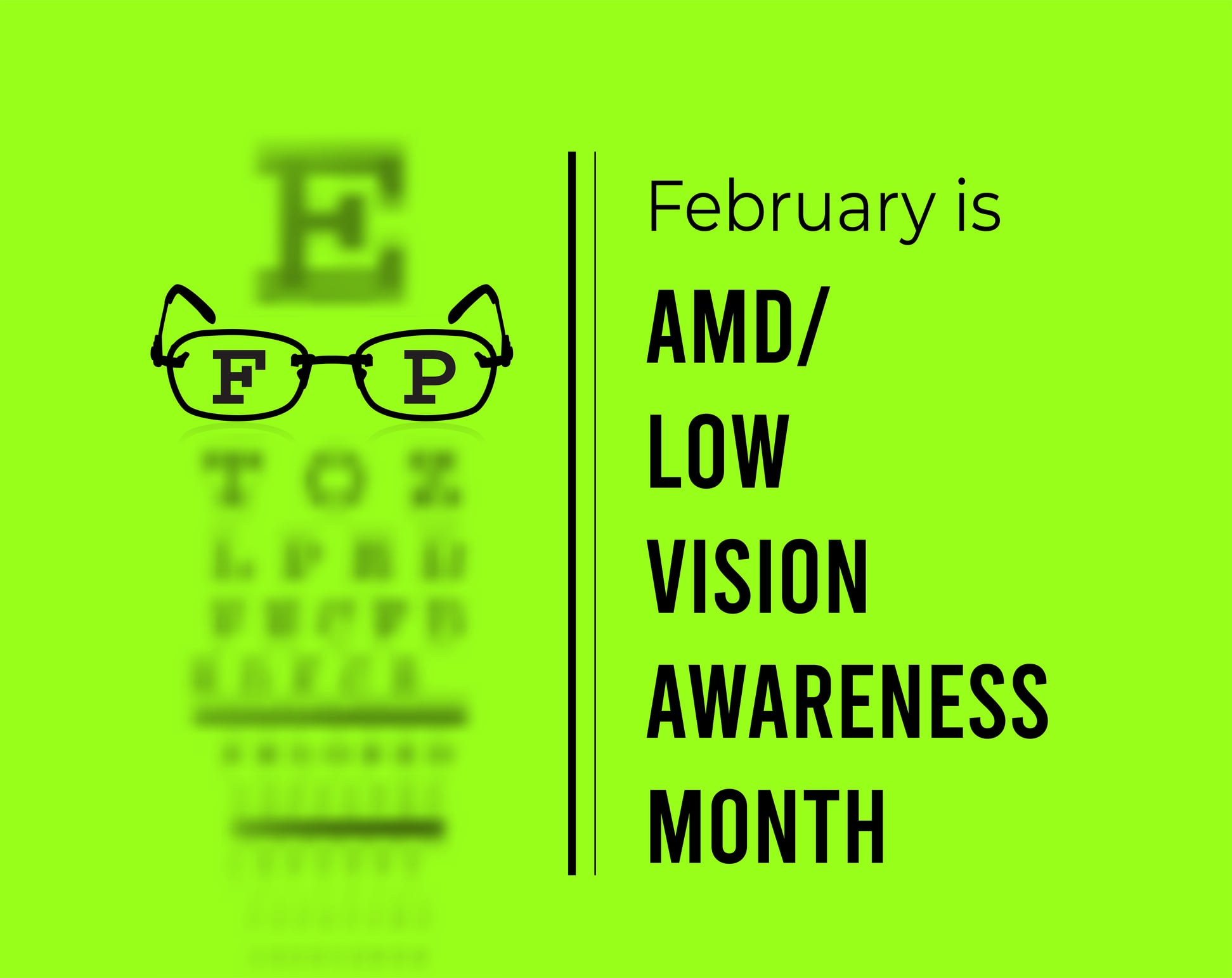
Age-Related Macular Degeneration Awareness Month

Age-related macular degeneration (AMD) is an eye disease that can blur your central vision. It occurs when aging damages the part of the eye that controls sharp, straight-ahead vision, called the macula. The macula is part of the retina, the light-sensitive tissue at the back of the eye. 

Age-related macular degeneration is a common condition and the most common cause of severe loss of eyesight among people 50 and older. It is important to note that people rarely go blind from it. However, losing your central vision makes it harder to see faces, read, drive, or do close-up work like cooking or fixing things around the house. 

There are two types of age-related macular degeneration: dry and wet. Most people with age-related macular degeneration have dry AMD, also called atrophic AMD. This is when the macular gets thinner with age. Dry AMD happens in three stages: 

  • Early 
  • Intermediate 
  • Late 

Wet AMD, also called advanced neovascular AMD, is a less common type of late AMD that causes faster vision loss. Dry AMD can turn into wet AMD at any stage; however, wet AMD always occurs in the late stage. 

The most common symptoms of age-related macular degeneration can include: 

  • Blurry or fuzzy vision 
  • Difficulty recognizing familiar faces 
  • Seeing straight lines appearing wavy 
  • A dark, empty area or blind spot appears in the center of a person’s vision 

The presence of tiny yellow deposits in the retina called drusen is one of the most common early signs of age-related macular degeneration. It can mean the eye is at risk of developing more severe age-related macular degeneration. 

Several risk factors that can contribute to developing age-related macular degeneration include: 

  • Eating a diet high in saturated fat 
  • Smoking 
  • High blood pressure or hypertension 

To diagnose age-related macular degeneration, an eye doctor will look at your medical history and perform an eye exam. They may also perform other tests to help diagnose AMD, including: 

  • A visual acuity test 
  • Pupil dilation 
  • Fluorescein angiography 
  • Amsler grid 

Specific treatment for age-related macular degeneration is determined by your eye doctor based on: 

  • Your age, overall health, and medical history 
  • The extent and nature of the disease 
  • Your tolerance for specific medications, procedures, or low-vision therapies 
  • The expectations for the course of the disease 
  • Your opinion or preference 

There is no current treatment for dry AMD; however, vision rehabilitation programs and low-vision devices can be used to build visual skills, develop new ways to perform daily living activities, and adjust to living with age-related macular degeneration. 

The main treatment for wet AMD is an injection of medications called anti-VEGF agents. VEGF stands for vascular endothelial growth factor. 

There is no cure for age-related macular degeneration. However, research shows that you may be able to lower your risk of AMD, or slow vision loss from AMD by: 

  • Quitting smoking 
  • Getting regular exercise 
  • Maintaining healthy blood pressure and cholesterol levels 
  • Eating healthy foods that include leafy green vegetables and fish 

AMD happens very slowly in some people and faster in others. If you have early AMD, you may not notice vision loss for a long time. It is important to get regular eye exams to find out if you have AMD. 

If you’re experiencing symptoms of dry or wet AMD, you can schedule an appointment at Jamaica Hospital Medical Center’s Ophthalmology Center by calling (718) 206-5900. 


All content of this newsletter is intended for general information purposes only and is not intended or implied to be a substitute for professional medical advice, diagnosis or treatment. Please consult a medical professional before adopting any of the suggestions on this page. You must never disregard professional medical advice or delay seeking medical treatment based upon any content of this newsletter. PROMPTLY CONSULT YOUR PHYSICIAN OR CALL 911 IF YOU BELIEVE YOU HAVE A MEDICAL EMERGENCY.

Age-Related Macular Degeneration

Age-related macular degeneration (AMD) is an eye disease that can blur your central vision. It occurs when aging damages the macula, the part of the eye that controls sharp, straight-ahead vision. The macula is part of the retina, the light-sensitive tissue at the back of the eye.

Age-related macular degeneration is a common condition and the most common cause of severe loss of eyesight among people 50 and older. It is important to realize that people rarely go blind from it. However, losing your central vision makes it harder to see faces, read, drive, or do close-up work like cooking or fixing things around the house.

There are two types of age-related macular degeneration, dry and wet.

Most people with age-related macular degeneration have dry AMD, also called atrophic AMD. This is when the macular gets thinner with age. Dry AMD happens in three stages:

  • Early
  • Intermediate
  • Late

Wet AMD, also called advanced neovascular AMD is a less common type of late AMD that causes faster vision loss. Dry AMD can turn into wet AMD at any stage, however, wet AMD is always late.

The most common symptoms of age-related macular degeneration can include:

  • Blurry or fuzzy vision
  • Difficulty recognizing familiar faces
  • Seeing straight lines appearing wavy
  • A dark, empty area or blind spot appears in the center of a person’s vision

The presence of tiny yellow deposits in the retina called drusen is one of the most common early signs of age-related macular degeneration. It can mean the eye is at risk of developing more severe age-related macular degeneration.

Several risk factors that can contribute to developing age-related macular degeneration include:

  • Eating a diet high in saturated fat
  • Smoking
  • High blood pressure or hypertension

To diagnose age-related macular degeneration, an eye doctor will look at your medical history and perform an eye exam. They may also perform other tests to help diagnose AMD, including:

  • A visual acuity test
  • Pupil dilation
  • Fluorescein angiography
  • Amsler grid

Specific treatment for age-related macular degeneration is determined by your eye doctor based on:

  • Your age, overall health, and medical history
  • The extent and nature of the disease
  • Your tolerance for specific medications, procedures, or low-vision therapies
  • The expectations for the course of the disease
  • Your opinion or preference

There is no current treatment for dry AMD, however, vision rehabilitation programs and low-vision devices can be used to build visual skills, develop new ways to perform daily living activities, and adjust to living with age-related macular degeneration.

The main treatment for wet AMD is an injection of medications called anti-VEGF agents. VEGF stands for vascular endothelial growth factor.

There is no cure for age-related macular degeneration. However, research shows that you may be able to lower your risk of AMD, or slow vision loss from AMD by:

  • Quitting smoking
  • Getting regular exercise
  • Maintaining healthy blood pressure and cholesterol levels
  • Eating healthy foods that include leafy green vegetables and fish

AMD happens very slowly in some people and faster in others. If you have early AMD, you may not notice vision loss for a long time. It is important to get regular eye exams to find out if you have AMD.

If you’re experiencing symptoms of dry or wet AMD, you can schedule an appointment at Jamaica Hospital Medical Center’s Ophthalmology Center by calling (718) 206-5900.

All content of this newsletter is intended for general information purposes only and is not intended or implied to be a substitute for professional medical advice, diagnosis or treatment. Please consult a medical professional before adopting any of the suggestions on this page. You must never disregard professional medical advice or delay seeking medical treatment based upon any content of this newsletter. PROMPTLY CONSULT YOUR PHYSICIAN OR CALL 911 IF YOU BELIEVE YOU HAVE A MEDICAL EMERGENCY.

Low Vision Awareness Month: What is Age-Related Macular Degeneration?

According to the American Academy of Ophthalmology, nearly three million Americans suffer from low vision, a visual impairment that cannot be corrected through medical treatments such as surgery, medication, or specialized eyewear. Low vision is most common among people aged 40 years and older.

One of the most common causes of low vision (and the leading cause of vision loss in people aged 50 and older) is age-related macular degeneration (AMD), which impairs a person’s central vision and interferes with tasks such as reading or driving. Your risk of developing this condition increases as you age, but this risk may be higher for people who have a family history of AMD, are Caucasian, or smoke.

This condition can occur as either “dry” (also known as “atrophic”) AMD or “wet” (also known as “advanced neovascular”) AMD. The majority of AMD cases involve dry AMD, which occurs in three stages: early, intermediate, and late.

Early dry AMD usually doesn’t involve any obvious symptoms, but during the intermediate stage, you may experience mild blurry vision or difficulties seeing in low lighting. Late AMD may cause symptoms such as straight lines appearing crooked, increased blurry vision, greater difficulty seeing in low lighting, colors appearing less bright, and visual blank spots.

There are no specific treatments available for the early stage of dry AMD, but during its intermediate and late stages, special dietary supplements may be able to slow or halt the progression of the disease. These supplements contain:

  • Vitamins C (500 milligrams)
  • Vitamin E (400 International Units)
  • Copper (2 milligrams)
  • Zinc (80 milligrams)
  • Beta-carotene
  • Lutein (10 milligrams)
  • Zeaxanthin (2 milligrams)

Wet AMD is a form of late-stage AMD that progresses quickly as abnormal blood vessels grow in the back of the eye, damaging the macula. It always begins as dry AMD and can occur during any stage of the condition. Unlike late-stage dry AMD, however, it can be treated through anti–vascular endothelial growth factor drugs or through photodynamic therapy (PDT), which combines injectable medications with laser treatments.

If you’re experiencing symptoms of dry or wet AMD, schedule an appointment at Jamaica Hospital Medical Center’s Ophthalmology Center now by calling (718) 206-5900.

All content of this newsletter is intended for general information purposes only and is not intended or implied to be a substitute for professional medical advice, diagnosis or treatment. Please consult a medical professional before adopting any of the suggestions on this page. You must never disregard professional medical advice or delay seeking medical treatment based upon any content of this newsletter. PROMPTLY CONSULT YOUR PHYSICIAN OR CALL 911 IF YOU BELIEVE YOU HAVE A MEDICAL EMERGENCY.