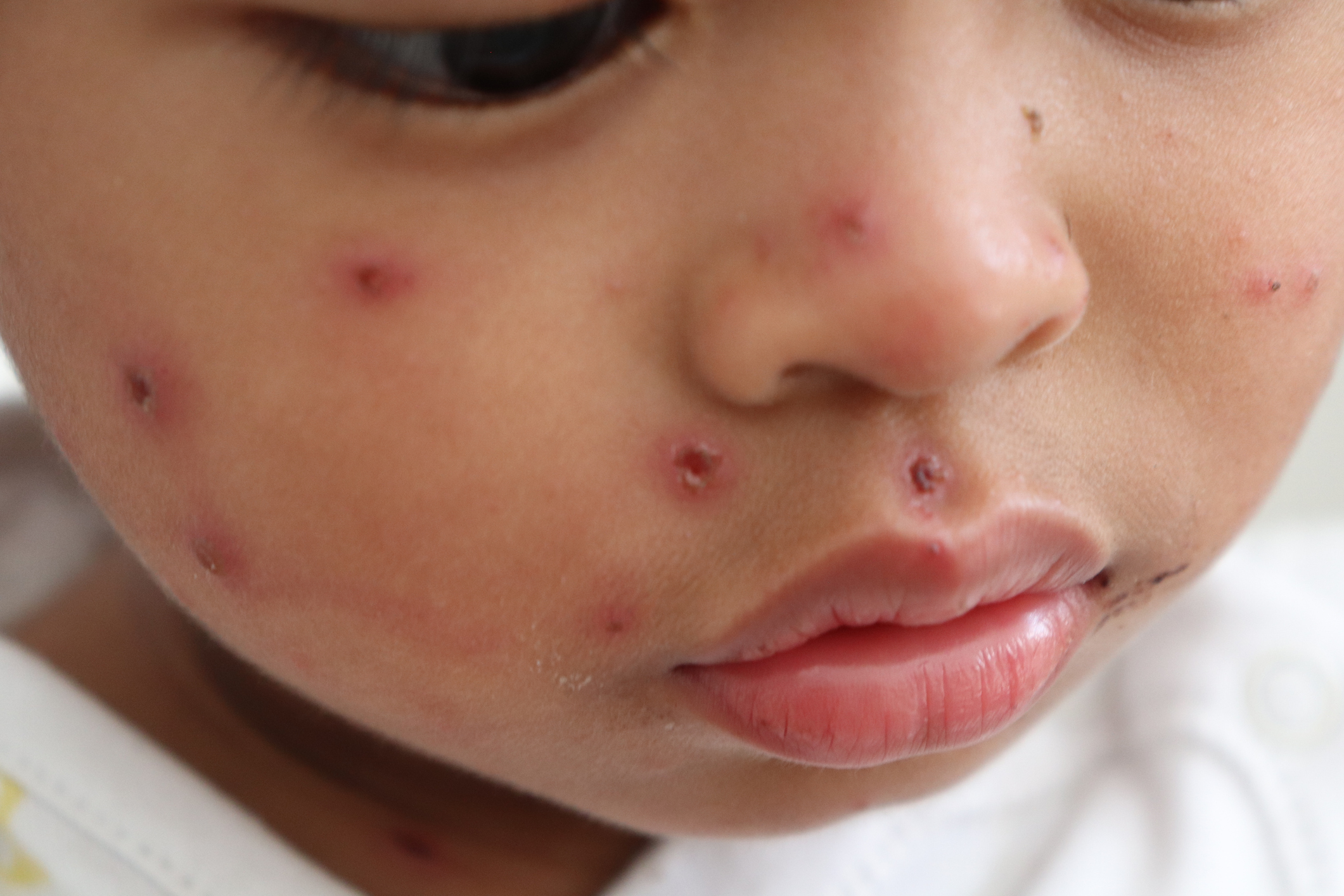
Measles

Measles is a highly contagious disease caused by the measles virus. It can affect anyone, but it is most common in children.

Some risk factors for measles include:

  • Being unvaccinated
  • Traveling internationally
  • Having a Vitamin A deficiency

Measles infects the respiratory tract and then spreads throughout the body. Signs and symptoms of measles appear around 10 to 14 days after exposure to the virus, including:

  • Fever
  • Dry cough
  • Runny nose
  • Sore throat
  • Inflamed eyes
  • Koplik’s spots (tiny white spots with bluish-white centers on a red background, which form on the inner lining of the cheek)
  • A skin rash made up of large, flat blotches that often flow into one another

The infection occurs in stages that span over two to three weeks. These stages include:

  • Infection and incubation- the measles virus spreads in the body for 10 to 14 days after infection. During that time, there are no signs or symptoms.
  • Nonspecific signs and symptoms- measles typically begins with a mild to moderate fever, a persistent cough, a runny nose, inflamed eyes, and a sore throat. This mild illness can last two to three days.
  • Acute illness and rash- a rash that can consist of small red spots, with some that may be slightly raised. Spots and bumps in tight clusters give the skin a splotchy red appearance. The face is usually the first place it appears. The rash spreads down the arms, chest, and back, then over the thighs, lower legs, and feet over the next few days. At the same time, the fever rises to temperatures as high as 104 to 105.8.
  • Recovery- the measles rash can last for about seven days. The rash fades gradually from the face and lastly the thighs and feet. As other symptoms go away, coughing and the darkening or peeling of the skin where the rash was, last about 10 days.

A person with measles can spread the virus to others for about eight days. Starting four days before the rash appears and ending when the rash has been present for four days.

When an infected person coughs, sneezes, or talks, infectious droplets spray into the air where others can breathe them in. Infectious droplets can stay in the air for about an hour and on a surface for several hours.

Many complications can arise from measles, including:

  • Diarrhea and vomiting
  • Ear infection
  • Bronchitis, laryngitis, or croup
  • Pneumonia
  • Encephalitis
  • Pregnancy problems

The U.S. Centers for Disease Control and Prevention (CDC) recommends that children and adults receive the measles vaccine to prevent infection.

Your healthcare provider can usually diagnose measles based on the disease’s characteristic rash and the Koplik’s spot on the inner lining of the cheek. Your healthcare provider may ask whether you or your child received measles vaccines, whether you traveled outside of the U.S. recently, and if you had contact with anyone who has a rash or fever.

The rash can be confused with many other illnesses. However, a blood test can be done to confirm whether the rash is measles. A test using a throat swab or urine sample can also be used.

There is no specific treatment for a measles infection once it occurs. Treatment can include providing comfort measures to relieve symptoms, such as rest and treating or preventing complications.

Some measures can be taken to protect individuals who don’t have immunity to measles after they have been exposed to the virus, including:

  • Post-exposure vaccination
  • Immune serum globulin
  • Medications
    • Fever reducers
    • Antibiotics
    • Vitamin A

If you become sick with severe symptoms, particularly after potential exposure to the measles virus, you must receive treatment from a doctor as soon as possible. You can schedule an appointment with a doctor at Jamaica Hospital Medical Center’s Ambulatory Care Center. Please call (718) 206-7001.

All content of this newsletter is intended for general information purposes only and is not intended or implied to be a substitute for professional medical advice, diagnosis or treatment. Please consult a medical professional before adopting any of the suggestions on this page. You must never disregard professional medical advice or delay seeking medical treatment based upon any content of this newsletter. PROMPTLY CONSULT YOUR PHYSICIAN OR CALL 911 IF YOU BELIEVE YOU HAVE A MEDICAL EMERGENCY.

Measles Outbreak Updates

measles outbreak nycMeasles is a highly contagious virus that causes a red spotted rash to spread all over the body, along with high fever, runny nose, cough, red eyes and sore throat. The virus can be very dangerous and potentially fatal for infants and children.

Recently, there has been an outbreak in the New York City area, and in an effort to contain the spread of the virus health officials are urging communities to keep up with the latest information and comply with recommendations.

To help educate our community, Jamaica Hospital is sharing the following information:

How has the measles outbreak affected NYC communities?

  • Close to 600 cases of measles have been reported in NYC since the fall of 2018, majority of which are from Brooklyn (Williamsburg, Borough Park, Crown Heights, and more recently Sunset Park); although most cases have been linked to unvaccinated travelers within Orthodox Jewish communities, the disease has also affected non-Orthodox Jewish residents in other boroughs including Queens.

How is the virus spreading?

  • Measles spreads when people breathe in or have direct contact with fluid that contains the virus. For example, it can pass through droplets sprayed into the air when someone with measles coughs or sneezes.
  • Measles can spread to others from four days before a rash appears through the fourth day after the rash disappears.
  • The best way to stop the spread of the virus is through the measles (MMR) vaccination.

How safe and effective is the MMR vaccine?

  • The MMR vaccine is very effective. Two doses of MMR vaccine are about 97% effective at preventing measles; one dose is about 93% effective.
  • Despite many claims that autism is linked to the MMR vaccine, multiple studies have scientifically proven that the measles vaccine is safe and not linked to autism.

Who gets the MMR vaccine?

  • All children should receive vaccination. The CDC recommends “children get two doses of MMR vaccine, starting with the first dose at 12 through 15 months of age, and the second dose at 4 through 6 years of age.”
  • Infants aged 6 to 11 months traveling abroad to high-risk areas should receive an early dose of MMR ( This dose would be in addition to the regular schedule of MMR vaccinations)
  • Teens and adults should also be up to date on their MMR vaccination.
  • Adults with no evidence of immunity (Individuals who may not have previously received vaccination, have no laboratory or written evidence of immunity)
  • Adults with no evidence of immunity and are at a higher risk for contracting measles. This group includes healthcare workers, international travelers, college students or those exposed to people with measles in the outbreak areas. (Adults who are at a high risk of transmission should receive two doses, 28 days apart).

Amelia MacIntyre DO- Family Medicine

All content of this newsletter is intended for general information purposes only and is not intended or implied to be a substitute for professional medical advice, diagnosis or treatment. Please consult a medical professional before adopting any of the suggestions on this page. You must never disregard professional medical advice or delay seeking medical treatment based upon any content of this newsletter. PROMPTLY CONSULT YOUR PHYSICIAN OR CALL 911 IF YOU BELIEVE YOU HAVE A MEDICAL EMERGENCY.

Know the Facts About the Measles

The measles virus has received a great deal of attention recently in New York City due to an infected tourist potentially exposing many residents in the five boroughs.

As the closest hospital to John F. Kennedy International Airport, where millions of foreign travelers fly in and out of each year and because we serve one the most ethnically diverse populations in the nation, Jamaica Hospital wants to provide our community with some very important information about the measles virus.

While vaccination programs have largely eliminated the measles in the United States, it is still common in other parts of the world with over 90,000 reported deaths attributed to the disease worldwide each year according to the Centers for Disease Control and Prevention (CDC).  In fact, most U.S. cases of the measles result from an unvaccinated international traveler exposing U.S. residents to the virus.

The measles virus is highly contagious and is spread through the air when an infected person sneezes or coughs.  Fever is typically the first symptom, followed by cough, runny nose and red eyes. Soon after, those infected will develop a rash of tiny red spots. The rash starts on the face and spreads to the rest of the body. Symptoms usually present ten to 14 days after exposure. Those with the disease can develop even more serious complications, and it is especially dangerous for young children.

The best way to prevent becoming infected is to get the MMR vaccine, which prevents against measles, mumps and rubella. The CDC recommends children receive two doses, the first between 12 to 15 months of age, and the second at four to six years old. Teens and adults should also be up-to-date with their MMR vaccination.

The MMR vaccine is safe and highly effective. The recommended two doses have proven to be 97% effective in preventing the measles virus.  While the MMR vaccine is recommended for everyone, it is especially important for those individuals who travel internationally or are exposed to travelers from foreign countries .

If you are experiencing symptoms consistent with the measles, seek medical attention immediately, but call your doctor or local hospital before arrival to prevent infecting others.

To learn more about the MMR vaccine, or to schedule an appointment to become vaccinated at Jamaica Hospital’s Ambulatory Care Center, please call 718-206-7001.

All content of this newsletter is intended for general information purposes only and is not intended or implied to be a substitute for professional medical advice, diagnosis or treatment. Please consult a medical professional before adopting any of the suggestions on this page. You must never disregard professional medical advice or delay seeking medical treatment based upon any content of this newsletter. PROMPTLY CONSULT YOUR PHYSICIAN OR CALL 911 IF YOU BELIEVE YOU HAVE A MEDICAL EMERGENCY.