
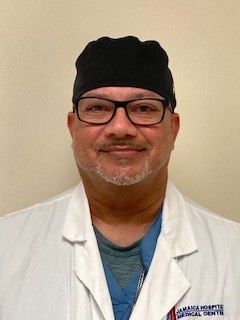
Employee Spotlight Shines on Jose Otero

This month, we are proud to shine our Employee Spotlight on Jose Otero, Special Care Associate (SCA) in the Cardiovascular Interventional Unit at Jamaica Hospital Medical Center.

Jose  began his employment at the hospital 27 years ago. He is a native of Brooklyn and still resides there. He attended PS 106 and completed his education at Bushwick High School. In his free time he enjoys building things in his home, different types of arts and crafts, painting and woodworking. He likes to improve his home with things that he has constructed on his own. Jose is fond of motorcycles and whenever he has the opportunity, he takes rides through scenic areas in and out of the city. He belongs to a group called the Latin American Motorcycle Association which has over 15,000 members worldwide. The group has members from all different professions who ride for the shear pleasure of being out on the roads, enjoying their time together. One day he hopes to travel to places that he has always wanted to visit.

Jose’s father was a professional musician who played many different types of instruments. This instilled in him a love of a wide variety of musical genres. He feels that through music people can communicate their feelings and music can also make people feel happy. His favorite sport are the martial arts. He has been practicing martial  arts for over 30 years and it has become like a religion to him. It takes a great deal of concentration and gives him much inner peace.

Family and friends are very important to Jose. He likes to make people smile whenever possible.  He feels that through his interactions with patients he can take away some of the anxiety and stress that they may be feeling. We are very fortunate to have Jose as a member of our team and look forward to having him continue with us for many more years.

All content of this newsletter is intended for general information purposes only and is not intended or implied to be a substitute for professional medical advice, diagnosis or treatment. Please consult a medical professional before adopting any of the suggestions on this page. You must never disregard professional medical advice or delay seeking medical treatment based upon any content of this newsletter. PROMPTLY CONSULT YOUR PHYSICIAN OR CALL 911 IF YOU BELIEVE YOU HAVE A MEDICAL EMERGENCY.

Potty Training Tips

Everyone who has ever experienced potty training  a child knows that it can be challenging. One of the challenges people encounter is deciding when to begin potty training. The average age for commencing potty training is between 18 months and two years of age. However, each child is different, and it may take more time. Girls typically start potty training earlier than boys.

Before beginning training,  it is important that children are able to:

  • Follow easy instructions
  • Walk to where a potty is located
  • Know what a potty is
  • Know how to communicate the need to go potty
  • Keep a diaper dry for two hours
  • Get on and off the potty easily
  • Take off their diaper or their clothes on their own

When training a child to go potty, establish a word or phrase that indicates that it is time to go potty. You can introduce the concept of using a potty by doing some practice first. That means with their clothes on so that they get accustomed to sitting on the potty. Giving a child some positive reinforcement when they use the potty is also helpful, even if they make an attempt and nothing happens. This can include verbal compliments and perhaps a sticker they can put on a piece of paper. Do not use words that have negative connotations about going to the potty. The potty should be kept in the same location in the home. It is important to set a routine for using it. Examples of this would be upon waking up in the morning, after a nap, 15 to 30 minutes after a meal,  or 45 minutes after drinking fluids.

Potty training isn’t always easy, and there will be times when a child may have an accident, but the process will get better with time. You can speak to your pediatrician for suggestions if you feel that there are issues with your child using the potty. If you would like to schedule an appointment with a pediatrician at Jamaica Hospital Medical Center, please call 718-206-7001.

All content of this newsletter is intended for general information purposes only and is not intended or implied to be a substitute for professional medical advice, diagnosis or treatment. Please consult a medical professional before adopting any of the suggestions on this page. You must never disregard professional medical advice or delay seeking medical treatment based upon any content of this newsletter. PROMPTLY CONSULT YOUR PHYSICIAN OR CALL 911 IF YOU BELIEVE YOU HAVE A MEDICAL EMERGENCY.

Low Vision Awareness Month

According to the American Academy of Ophthalmology, nearly three million Americans suffer from low vision, a visual impairment that cannot be corrected through medical treatments such as surgery, medication, or specialized eyewear. Low vision is most common among people aged 40 years and older.

One of the most common causes of low vision (and the leading cause of vision loss in people aged 50 and older) is age-related macular degeneration (AMD), which impairs a person’s central vision and interferes with tasks such as reading or driving. Your risk of developing this condition increases as you age, but this risk may be higher for people who have a family history of AMD, are Caucasian, or smoke.

This condition can occur as either “dry” (also known as “atrophic”) AMD or “wet” (also known as “advanced neovascular”) AMD. The majority of AMD cases involve dry AMD, which occurs in three stages: early, intermediate, and late.

Early dry AMD usually doesn’t involve any obvious symptoms, but during the intermediate stage, you may experience mild blurry vision or difficulties seeing in low lighting. Late AMD may cause symptoms such as straight lines appearing crooked, increased blurry vision, greater difficulty seeing in low lighting, colors appearing less bright, and visual blank spots.

There are no specific treatments available for the early stage of dry AMD, but during its intermediate and late stages, special dietary supplements may be able to slow or halt the progression of the disease. These supplements contain:

  • Vitamins C (500 milligrams)
  • Vitamin E (400 International Units)
  • Copper (2 milligrams)
  • Zinc (80 milligrams)
  • Beta-carotene
  • Lutein (10 milligrams)
  • Zeaxanthin (2 milligrams)

Wet AMD is a form of late-stage AMD that progresses quickly as abnormal blood vessels grow in the back of the eye, damaging the macula. It always begins as dry AMD and can occur during any stage of the condition. Unlike late-stage dry AMD, however, it can be treated through anti–vascular endothelial growth factor drugs or through photodynamic therapy (PDT), which combines injectable medications with laser treatments.

If you’re experiencing symptoms of dry or wet AMD, schedule an appointment at Jamaica Hospital Medical Center’s Ophthalmology Center now by calling (718) 206-5900.

All content of this newsletter is intended for general information purposes only and is not intended or implied to be a substitute for professional medical advice, diagnosis or treatment. Please consult a medical professional before adopting any of the suggestions on this page. You must never disregard professional medical advice or delay seeking medical treatment based upon any content of this newsletter. PROMPTLY CONSULT YOUR PHYSICIAN OR CALL 911 IF YOU BELIEVE YOU HAVE A MEDICAL EMERGENCY.

Employee Spotlight Shines on Christa Deleon

This month, we are proud to shine our Employee Spotlight on Christa Deleon, Executive Administrative Assistant in our Food and Nutrition Department.

Christa has been working at Jamaica Hospital Medical Center for 10 years. She grew up in Island Trees on Long Island  and currently resides in Levittown. Christa attended Island Trees Elementary School and Island Trees High School. She graduated from Berkley College where she received her bachelor’s degree.

She has two sons, Luca and Massimo who are seven and five years of age. Christa also has a one year old  female American Bully who’s name is Raven.  One of Christa’s favorite things to do is to spend time with her sons,  her family and friends. She likes to try all types of new restaurants, but her favorite would be anything Italian.

Christa loves to travel. She has been to many different cities both domestically and internationally, including Paris, Washington D.C and her favorite place to go on vacation is to Aruba. One of the countries she would like to visit one day is Italy. Christa enjoys reading, especially psychological thrillers. She likes all different types of music. Her sons play football, soccer and lacrosse and she enjoys watching them when they are playing. Christa used to play softball and soccer and is an avid hockey fan. Her favorite hockey team is the New York Islanders.

Christa enjoys working at Jamaica Hospital because of the diversity of the staff and our patients. She feels as though she has learned a lot culturally and linguistically. Christa is proud to be part of a team that has a positive impact on people’s lives and their health.  We look forward to her working with us for many more years into the future.

All content of this newsletter is intended for general information purposes only and is not intended or implied to be a substitute for professional medical advice, diagnosis or treatment. Please consult a medical professional before adopting any of the suggestions on this page. You must never disregard professional medical advice or delay seeking medical treatment based upon any content of this newsletter. PROMPTLY CONSULT YOUR PHYSICIAN OR CALL 911 IF YOU BELIEVE YOU HAVE A MEDICAL EMERGENCY.

Tips To Help You Your New Year’s Resolutions

The beginning of every new year always seems to be a great time to make resolutions for changes to something in our lives. However, these New Year’s resolutions are often easier to make than to keep.

Here are some tips to help you keep your New Year’s resolutions:

  • Select one goal that you want to achieve instead of many
  • Plan in advance how you intend to achieve your goal
  • Don’t be too ambitious with your goal, it is best to keep it simple
  • Break up your goal into smaller, manageable parts
  • Pick a goal that involves a new activity
  • Try to learn from past challenges with achieving your goals
  • Don’t let yourself become discouraged if you have setbacks
  • Keep a daily log of your progress
  • Pick a goal where you can measure the results

Achieving a goal that you made as your New Year’s resolution is always easier when you have the support of friends and family.  Let people know what you hope to achieve and enlist others who can be supportive.  Additionally, give yourself some positive reinforcement when you are working towards a goal.

All content of this newsletter is intended for general information purposes only and is not intended or implied to be a substitute for professional medical advice, diagnosis or treatment. Please consult a medical professional before adopting any of the suggestions on this page. You must never disregard professional medical advice or delay seeking medical treatment based upon any content of this newsletter. PROMPTLY CONSULT YOUR PHYSICIAN OR CALL 911 IF YOU BELIEVE YOU HAVE A MEDICAL EMERGENCY.

A Recipe for Healthy Chicken Soup

Not only does a bowl of chicken soup help keep us warm in the winter, its ingredients may also provide several benefits for our health. Here is a recipe from the National Foundation for Cancer Research for chicken soup that is both healthy and delicious. https://www.nfcr.org/blog/chicken-soup-helps-soothe-the-common-symptoms-of-cold-flu-and-mild-covid-19/?gad_source=1&gclid=EAIaIQobChMIoKOfvpLEgwMV_mBHAR0u_wzQEAMYASAAEgKmf_D_BwE

All content of this newsletter is intended for general information purposes only and is not intended or implied to be a substitute for professional medical advice, diagnosis or treatment. Please consult a medical professional before adopting any of the suggestions on this page. You must never disregard professional medical advice or delay seeking medical treatment based upon any content of this newsletter. PROMPTLY CONSULT YOUR PHYSICIAN OR CALL 911 IF YOU BELIEVE YOU HAVE A MEDICAL EMERGENCY.

January is Glaucoma Awareness Month

Glaucoma is a group of eye diseases that mainly affects people who are middle aged or older, but it can affect anyone at any age. There are more than three million people in the United States and 60 million people worldwide who suffer from glaucoma. Glaucoma is the second leading cause of blindness. Typically the disease starts to develop suddenly, often without symptoms,  and once vision is lost, it is permanent. As much as 40 percent of vision can be lost before some people even notice a problem. It usually starts with loss of peripheral vision. Glaucoma  is caused by damage to the optic nerve so that the  brain isn’t able to receive images from the eyes. There are two types of Glaucoma, Primary Open-Angle Glaucoma where pressure inside the eye increases on its own and damages the optic nerve and Secondary Glaucoma where another disease causes the pressure in the eye to increase and that results in optic nerve damage. Both types will eventually lead to blindness. Early detection of Glaucoma can help to slow down the progression of the disease. Regular eye exams are very important. To schedule an appointment with an eye doctor at Jamaica Hospital Medical Center, please call 718- 206-5900.

All content of this newsletter is intended for general information purposes only and is not intended or implied to be a substitute for professional medical advice, diagnosis or treatment. Please consult a medical professional before adopting any of the suggestions on this page. You must never disregard professional medical advice or delay seeking medical treatment based upon any content of this newsletter. PROMPTLY CONSULT YOUR PHYSICIAN OR CALL 911 IF YOU BELIEVE YOU HAVE A MEDICAL EMERGENCY.

Yorkshire Pudding Recipe

Enjoy the holiday season with this delicious recipe from the Food Network for Yorkshire Pudding. https://www.foodnetwork.com/recipes/tyler-florence/yorkshire-pudding-recipe-1943597

All content of this newsletter is intended for general information purposes only and is not intended or implied to be a substitute for professional medical advice, diagnosis or treatment. Please consult a medical professional before adopting any of the suggestions on this page. You must never disregard professional medical advice or delay seeking medical treatment based upon any content of this newsletter. PROMPTLY CONSULT YOUR PHYSICIAN OR CALL 911 IF YOU BELIEVE YOU HAVE A MEDICAL EMERGENCY.

Tips to Maintain Dental Health During the Holidays

The holiday season is a wonderful time of year. While it is easy to get caught up in the merriment, we need be to be mindful of the effects all of the holiday festivities can have on our dental health. With sweet treats all around us, one particular cause of concern is how our teeth can be impacted.

Here are a few tips to help make sure we maintain good oral health into the new year:

  • Don’t forget your dental routine – No matter how busy you get this holiday season, don’t forget to practice good oral hygiene.
  • Eat healthy – Cookies and sweets are nice holiday treats, but instead of reaching for another candy cane, take a cue from the reindeer and fill your plate with vegetables, such as carrots.
  • Drink healthy – Avoid drinking sodas, sports drinks and juices with lots of sugar. Instead, drink water with fluoride in it to keep your teeth strong and healthy. If you want something bubbly, try carbonated water. If you must drink soda, use a straw to keep most of the acid off your teeth.
  • Be responsible while drinking alcohol – Aside from all the obvious reasons to be responsible when consuming alcohol, also know that it can affect your teeth. Red wine can stain your teeth and the acid in most alcoholic beverages can also be damaging.
  • Don’t skip your dental visit – We all know how hectic the holidays are, but whether it is a regular check-up or a visit to deal with an existing issue, it is important to make the time to honor your regular dental visit and not out it off until after the holidays.
  • Don’t use your teeth as a tool – Avoid using your teeth to tear open packages, tear tape or ribbons, or cracking nuts. These types of cations can lead to chips or breaks.
  • Stuff your stocking wisely – Sugary treats such as candy canes are a holiday staple, but try to limit the number of sweets in Christmas stockings that can lead to cavities. Use the holidays as an opportunity to replace everyone in the family’s toothbrush by dropping one in each stocking.

By following these simple dental tips, you can avoid being placed on Santa’s naughty list this year.

All content of this newsletter is intended for general information purposes only and is not intended or implied to be a substitute for professional medical advice, diagnosis or treatment. Please consult a medical professional before adopting any of the suggestions on this page. You must never disregard professional medical advice or delay seeking medical treatment based upon any content of this newsletter. PROMPTLY CONSULT YOUR PHYSICIAN OR CALL 911 IF YOU BELIEVE YOU HAVE A MEDICAL EMERGENCY.

A Healthy Thanksgiving Recipe – Sauteed Spinach with Garlic and Lemon

Thanksgiving dinner can be accompanied by healthy side dishes this year.  Here is a recipe from Good Housekeeping  for sauteed spinach with garlic and lemon that is easy to prepare, delicious  and most importantly, very healthy.  https://www.goodhousekeeping.com/food-recipes/a34349776/glazed-green-beans-recipe/

All content of this newsletter is intended for general information purposes only and is not intended or implied to be a substitute for professional medical advice, diagnosis or treatment. Please consult a medical professional before adopting any of the suggestions on this page. You must never disregard professional medical advice or delay seeking medical treatment based upon any content of this newsletter. PROMPTLY CONSULT YOUR PHYSICIAN OR CALL 911 IF YOU BELIEVE YOU HAVE A MEDICAL EMERGENCY.