
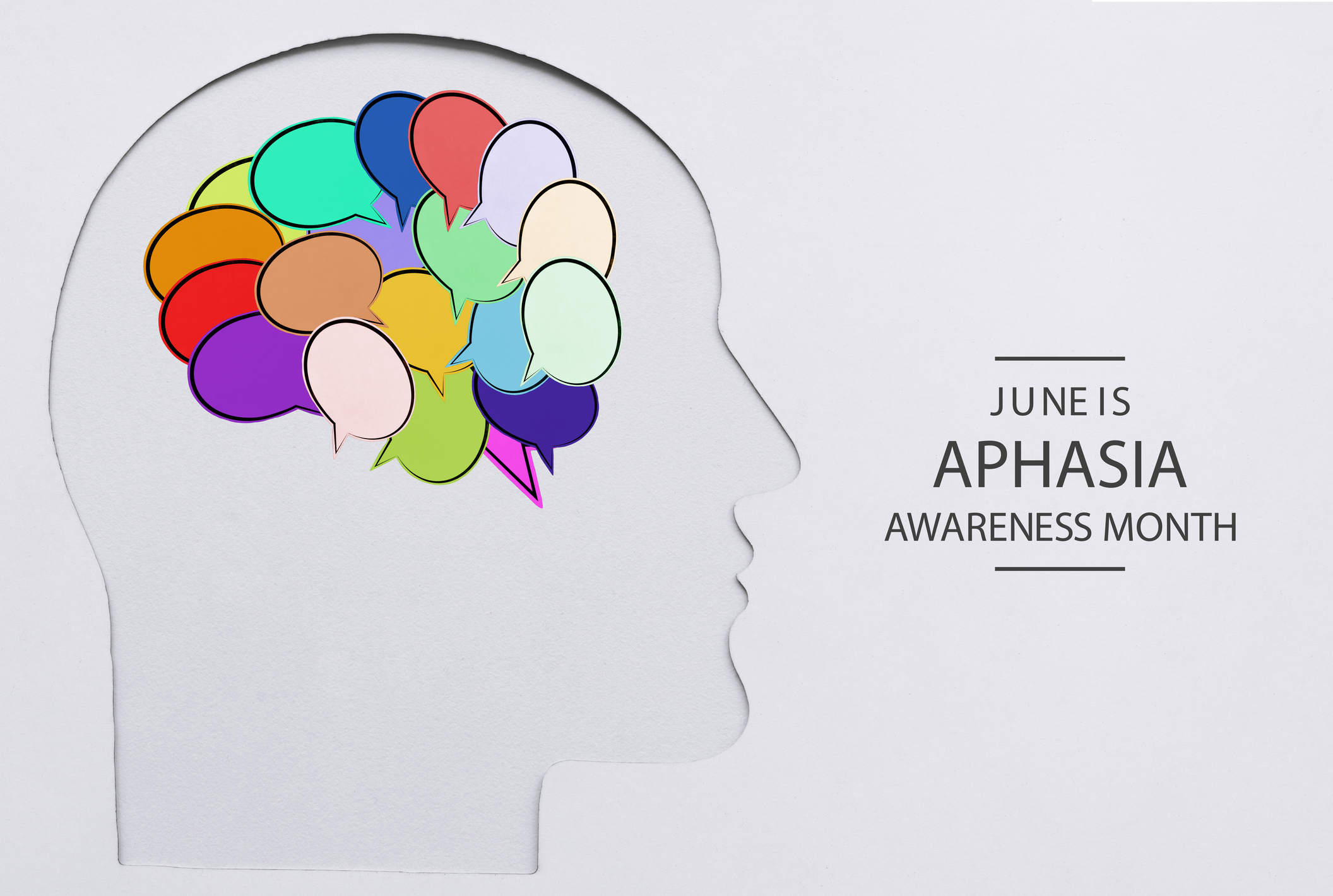
 June is National Aphasia Awareness Month, a month dedicated to increasing understanding of aphasia. This acquired communication disorder impairs a person’s ability to process language but does not affect their intelligence.
Aphasia affects the ability to speak and understand others, causing most people with the disorder to have trouble reading and writing.
The most common cause of aphasia is stroke. About 25 to 40 percent of stroke survivors are afflicted with aphasia. It can also be a result of a head injury, a brain tumor, or other neurological causes.
There are six types of aphasia, including:
- Global aphasia is the most severe form of aphasia and is applied to patients who can produce few recognizable words and understand little or no spoken language. People with global aphasia can’t read or write. It is often seen immediately after the patient has suffered a stroke and may rapidly improve if the damage to the brain has not been too extensive. However, with greater brain damage, there may be severe and lasting disability.
- Broca’s aphasia, or non-fluent aphasia, is a form of aphasia in which the speech output is severely reduced and is limited mainly to short utterances of less than four words. A person’s vocabulary access is limited, and so is their ability to form sounds.
- Mixed non-fluent aphasia is a form of aphasia that applies to people with sparse and effortful speech, which can resemble severe Broca’s aphasia. However, they remain limited in their speech comprehension and do not read or write beyond an elementary level.
- Wernicke’s aphasia, or fluent aphasia, is a form of aphasia in which the ability to grasp the meaning of spoken words is impaired. However, the ease of producing connected speech is not much affected. Reading and writing are often severely impaired.
- Anomic aphasia is a form of aphasia that is applied to people left with a persistent inability to supply the words for the things they want to say, particularly significant nouns and verbs.
- Primary progressive aphasia (PPA) is a neurological syndrome in which language capabilities become slowly and progressively impaired. Unlike the other forms of aphasia that result from stroke or brain injury, PPA is caused by Alzheimer’s or frontotemporal lobar degeneration.
A healthcare provider can diagnose aphasia by performing physical and neurological exams. They can also use imaging tests, such as an MRI and a CT scan, to identify what is causing aphasia.
Aphasia can also be diagnosed with the help of a speech-language pathologist who can complete a comprehensive language assessment to confirm the presence of aphasia and determine the appropriate course of language treatment.
The assessment helps find out whether the person can:
- Name common objects
- Engage in a conversation
- Understand and use words correctly
- Answer questions about something read or heard
- Repeat words and sentences
- Follow instructions
- Answer yes and no questions and respond to open-ended questions about common subjects
- Read and write
There are several treatments for aphasia, including:
Speech and language rehabilitation therapy aims to improve the ability to communicate and help restore as much language as possible. This is done by teaching the person with aphasia how to make up for lost language skills and find other communication methods. This therapy:
- Starts early
- Often works in groups
- May include the use of computers
Medications are being studied to treat aphasia that may improve blood flow to the brain and enhance its ability to recover or help replace the depleted chemicals in the brain.
Brain stimulations, such as transcranial magnetic and direct current stimulation, are being studied to help improve the ability to name things.
Because aphasia is often a sign of a serious problem, such as a stroke, seek emergency medical care if you suddenly develop any symptoms.
If you are experiencing any symptoms of aphasia, you can consult with a neurologist at Jamaica Hospital Medical Center. To schedule an appointment, please call (718) 206-7246.
 Follow
All content of this newsletter is intended for general information purposes only and is not intended or implied to be a substitute for professional medical advice, diagnosis or treatment. Please consult a medical professional before adopting any of the suggestions on this page. You must never disregard professional medical advice or delay seeking medical treatment based upon any content of this newsletter. PROMPTLY CONSULT YOUR PHYSICIAN OR CALL 911 IF YOU BELIEVE YOU HAVE A MEDICAL EMERGENCY.